
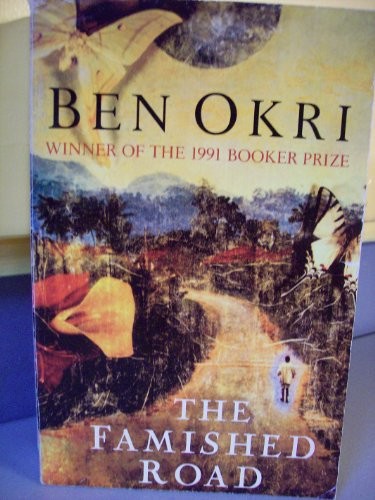
The Famished Road
Ben Okri · b. 1959 · Nigeria
Why it matters
Azaro, a spirit-child who keeps choosing to stay among the hungry living, wanders a Nigerian ghetto where spirits crowd the bar. Booker winner: magical realism rooted in Yoruba cosmology rather than borrowed from Macondo.
At a glance
Hallucinatory, cyclical narrative dissolves the line between spirit world and reality throughout.
Deep dive
Why the road at the center of Okri's Booker winner is always hungry, and why the first book of a trilogy refuses to let its ending settle anything.
Written for readers who have finished the book. No plot recap, and nothing here is safe to read first.
Themes & symbolism
Azaro is an abiku, a Yoruba spirit-child bound by a pact made among his spirit companions to die in infancy and return to them — and the novel opens with him already having broken that pact once, choosing to remain among the living despite his companions' constant, seductive attempts to call him back. Okri makes that choice recur rather than resolve it once: Azaro has to keep choosing to stay, scene after scene, which turns his private cosmology into political allegory for a country — implicitly Nigeria on the eve of independence — trying to break its own cycles of poverty and exploitation through repeated acts of will rather than a single victory.
The road of the title is a literal hungry entity within the novel's mythology, always wanting to be fed with lives, and the narrative's own geography obeys the same logic — paths loop back on themselves, episodes recur with variation, chronology refuses to resolve into forward motion because the road itself won't let it. Political violence supplies the novel's other register of appetite: thugs from the Party of the Rich and Party of the Poor bribe voters with poisoned milk and staged rallies, and Okri folds this predation into the same continuous hunger driving the spirit world, so that money, power, and metaphysics all consume the poor by the same mechanism. Azaro's father, Dad, answers that hunger with his own escalating body — he takes up bare-knuckle boxing under names like the Black Tyger, absorbing beating after beating in the ring the way the family absorbs beating after beating from poverty itself, until his fighting curdles into half-mad, half-prophetic visions that make him a kind of unlicensed folk politician for a neighborhood with no other champion available to it.
A Trilogy That Refuses to Close
The Famished Road is the first of three novels — followed by Songs of Enchantment and Infinite Riches — and its ending is deliberately not an ending: Azaro chooses, again, to stay among the living, but the spirit world's pull and the road's hunger are left fully intact, unresolved threats rather than defeated ones. That refusal is the novel's formal argument in miniature: a book about a country and a boy both mid-struggle shouldn't hand either one a premature victory, so Okri closes on continuation rather than resolution, trusting the reader to feel the difference.
A Cosmology, Not a Borrowed Style
Reviewers reached quickly for García Márquez when the novel won the Booker Prize in 1991, making Okri, then in his early thirties, one of its youngest winners — but the comparison undersells what the book is doing. Its spirit-world logic is drawn specifically from Yoruba abiku belief and the rhythms of West African oral storytelling, not translated wholesale from Macondo; the famished road, the spirit companions, and Madame Koto's bar as a threshold between worlds all have a local cosmological grammar the novel trusts readers to learn on its own terms rather than one imported ready-made from another continent's literature.
Where to go next
 Chinua Achebe · 1958Things Fall ApartLvl 4Medium pace
 Gabriel García Márquez · 1967One Hundred Years of SolitudeLvl 6Medium pace
 Ngũgĩ wa Thiong'o · 1967A Grain of WheatLvl 6Slow burn
 Tsitsi Dangarembga · 1988Nervous ConditionsLvl 4Medium pace
 Ayi Kwei Armah · 1968The Beautyful Ones Are Not Yet BornLvl 6Slow burn
 Wole Soyinka · 1975Death and the King's HorsemanLvl 6Medium pace