

The End of the Affair
Graham Greene · 1904–1991 · England
Why it matters
A jealous lover investigates why his wartime mistress left him, and stumbles into a duel with God. Greene's most personal novel turns adultery into a study of faith, hatred, and the terror of being loved.
At a glance
A fractured timeline and diary-within-narrative structure complicate a short book.
Deep dive
A jealous novelist hires a detective to dig up why his wartime lover left him without warning, certain the answer is a rival man, and Greene has him find something far harder to argue with.
Written for readers who have finished the book. No plot recap, and nothing here is safe to read first.
Themes & symbolism
Maurice Bendrix narrates the novel as an act of sustained jealousy, opening not with love but with hatred, his own admitted hatred of Sarah Miles and of the God he does not believe he believes in, and Greene structures the whole book as Bendrix's retrospective attempt to master a story that has already defeated him: hiring a private detective to investigate why Sarah abandoned their affair years earlier, convinced a rational, worldly explanation, another lover, must exist, because the alternative explanation, however uncomfortable, is more threatening to everything Bendrix has organized his identity around as a committed atheist.
Sarah's diary, obtained partway through the novel, reverses the entire narrative's authority: what Bendrix has spent the book investigating as a mystery of infidelity turns out to be a private, anguished record of religious conversion, a promise made to a God Sarah did not previously believe in, bargained during an air raid that Bendrix survived, that she would give him up if he lived. Greene's structural trick, letting Bendrix's jealous detective plot collide directly with Sarah's spiritual crisis, forces the novel's real subject into view: a man capable of imagining every rival except the one that actually took her, because it isn't a person at all.
Greene, a Catholic convert himself, uses Bendrix's furious, articulate atheism as the novel's most sustained theological argument rather than a strawman to be corrected; Bendrix never stops resenting God even as the narrative keeps accumulating evidence, a doubting priest's testimony, small inexplicable incidents surrounding Sarah after her death, that resists his preferred rational explanations. The novel's genuine achievement is refusing to resolve that argument cleanly in either direction: Bendrix's hatred of God is, by the book's own logic, itself a kind of involuntary faith, since a person cannot convincingly hate what he is certain does not exist.
A War Novel Fought Entirely Indoors
Greene sets the affair's beginning and crisis during the London Blitz, and the air raid that triggers Sarah's vow, Bendrix apparently killed by a bomb blast and then found alive, gives the novel its hinge between wartime peril and religious bargaining, a device Greene drew from his own wartime affair with Catherine Walston, to whom the novel is dedicated. Unlike most fiction of the period that stages the Blitz as collective national experience, Greene keeps the war almost entirely offstage, a mechanism for producing one private, world-altering promise inside one bedroom, which is consistent with the novel's whole method: history here exists only as the pressure that forces private, spiritual decisions into being.
The last seal: what actually happens, and why it lands the way it does.
The ending, explained
Sarah, it emerges, had been quietly ill for some time and dies of pneumonia not long after Bendrix, having read her diary, tracks her down and the two briefly, painfully reconcile before her death; her husband Henry, oblivious to the affair throughout, is left a widower comforted, awkwardly, by the very man who betrayed him. In the aftermath, small, unwilled miracles seem to accumulate around Sarah's memory, a disfigured child healed after praying at her grave, the atheist detective's son cured of appendicitis after contact with one of her books, incidents Greene refuses to either confirm as genuinely supernatural or dismiss as coincidence. Bendrix, still furiously insisting he does not believe, closes the novel less as a converted man than as a man who has run out of ways to avoid the conclusion Sarah reached before him: that God, whether or not Bendrix wants it to be true, has become an unavoidable rival he can no longer simply argue out of existence.
Where to go next
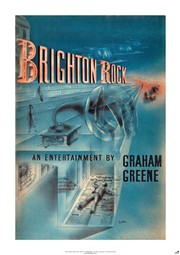 Graham Greene · 1938Brighton RockLvl 5Fast paced
 Graham Greene · 1940The Power and the GloryLvl 5Medium pace
 Graham Greene · 1950The Third ManLvl 3Fast paced
 Graham Greene · 1955The Quiet AmericanLvl 5Medium pace
 Graham Greene · 1958Our Man in HavanaLvl 4Fast paced
 Joseph Conrad · 1899Heart of DarknessLvl 7Slow burn