
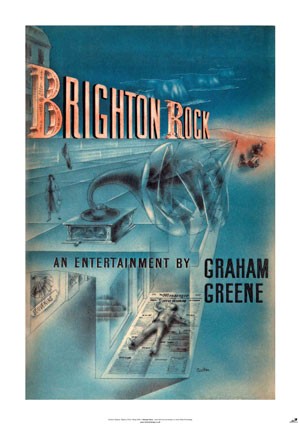
Brighton Rock
Graham Greene · 1904–1991 · England
Why it matters
Seventeen-year-old gangster Pinkie marries a witness to keep her silent, damning himself with open eyes. Greene's first great 'entertainment' fuses pulp thriller with Catholic theology into a study of evil as a form of certainty.
At a glance
Brisk noir plotting carries a surprisingly severe theological argument about damnation.
Deep dive
Greene sets a teenage gangster's Catholic damnation against Ida Arnold's cheerful, entirely secular idea of right and wrong, and lets the reader decide which code actually protects anyone.
Written for readers who have finished the book. No plot recap, and nothing here is safe to read first.
Themes & symbolism
Pinkie Brown is seventeen and already running Kite's old mob, and Greene makes his cruelty inseparable from a Catholic theology absorbed in the slums of Paradise Piece: Pinkie believes in Hell with a literalism nobody else in the novel bothers to muster, and that belief, not any absence of conscience, is what lets him treat murder as a manageable sin among the many he already assumes he's damned for.
Rose, the seventeen-year-old café waitress who falls for him, shares his Catholic instincts without sharing his despair, and her decision to marry him at the registry office, fully aware of what he is, reads less as naivety than as a theological choice of its own: she would rather be damned alongside Pinkie than saved apart from him, a logic of love Greene treats as genuinely, terribly coherent rather than as a girl's mistake to be corrected.
Charles Hale, working undercover for a newspaper stunt under the byline Kolley Kibber, arrives in Brighton already marked for death by Pinkie's gang in retaliation for the death of their old boss Kite, and Greene opens the novel inside Hale's own dread during his last free hours before dropping him entirely, a structural choice that hands the reader guilty knowledge of the killing that only Ida, hunting the truth for the rest of the book, has to earn.
Ida Arnold's Fairground Morality
Ida Arnold, the boozy, warm-blooded amateur detective who takes up Charles Hale's death as a personal cause, gives the novel its other moral register entirely: she works from ouija boards, seaside common sense, and an appetite for fair play and a good time, categories of right and wrong with no Hell in them at all. Greene stacks her decency against Pinkie's damnation on purpose, Ida is by far the more effective force for justice in the plot, chasing down the truth and saving Rose from herself, but the novel keeps suggesting that her cheerful secular code cannot actually see what is happening inside Pinkie or Rose, only what happens to them.
The last seal: what actually happens, and why it lands the way it does.
The ending, explained
Cornered by Ida and the police on the cliffs above Brighton, Pinkie is disfigured and then killed by the bottle of vitriol he means for Rose, thrown back at him in the chaos, closing off the murder spree that began with Hale's killing at the novel's start. Rose, pregnant and still believing herself damned alongside her husband, is left with a recording Pinkie made for her earlier at a boardwalk booth, meant to curdle any tenderness she felt into hatred, but the shop's needle sticks in the run-out groove on the words I hate you repeated over and over, and Greene ends before revealing whether Rose ever hears the venomous rest waiting on the other side of that groove. A priest's closing words to her, about the appalling strangeness of the mercy of God, offer the only comfort the novel allows, and it is deliberately unclear whether Rose, or the reader, is meant to trust it.
Where to go next
 Graham Greene · 1940The Power and the GloryLvl 5Medium pace
 Graham Greene · 1950The Third ManLvl 3Fast paced
 Graham Greene · 1951The End of the AffairLvl 5Medium pace
 Graham Greene · 1955The Quiet AmericanLvl 5Medium pace
 Graham Greene · 1958Our Man in HavanaLvl 4Fast paced
 Joseph Conrad · 1899Heart of DarknessLvl 7Slow burn