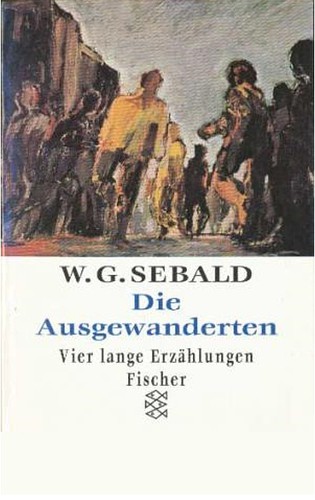
The Emigrants
W. G. Sebald · 1944–2001 · Germany / England
Originally Die Ausgewanderten (German) · translated by Michael Hulse
Why it matters
Four displaced lives: quiet, photographed, ruined at long distance by the German catastrophe. The book that announced Sebald's method: the Holocaust approached only obliquely, and all the more devastating for it.
At a glance
Long unbroken paragraphs interleaved with unexplained photographs across four life stories.
Deep dive
Four separate lives, told by the same quiet narrator tracking down whoever remembers them, keep circling the same unspoken fact about what it cost to survive Europe's twentieth century by leaving it.
Written for readers who have finished the book. No plot recap, and nothing here is safe to read first.
Themes & symbolism
Sebald structures the book as four discrete biographical excavations, Dr. Henry Selwyn, the schoolteacher Paul Bereyter, the butler Ambros Adelwarth, and the painter Max Ferber, each pursued by a narrator whose own connection to the subject, a former landlord, a childhood teacher, a great-uncle by marriage, a Manchester acquaintance, is always genuinely incidental, and that incidental quality is the method: Sebald is arguing that the twentieth century's catastrophe survives less in official history than in the scattered, half-noticed lives of people who carry it without ever fully speaking it aloud, waiting for someone patient enough to ask the right questions decades later.
Each of the four men has, in some way, changed his name, his nationality, or his profession to survive displacement, Selwyn born Hersch Seweryn in Lithuania, Ferber's parents deported and murdered while he escaped to England as a child, and Sebald traces how completely that survival required a kind of self-erasure that outlives the original danger: none of the four men Sebald profiles ever fully reconstitutes a stable identity on the far side of exile, even the ones, like Adelwarth, who achieve real worldly success. The book's persistent, embedded photographs, family portraits, buildings, unlabeled snapshots reproduced directly in the text without conventional captions, work the same way memory does in Sebald's telling: evidentiary and utterly insufficient at once, proof that something happened without ever explaining what it actually felt like from inside.
Sebald's prose, long, winding sentences that fold multiple timeframes and multiple tellers into a single unbroken paragraph, formally enacts the book's argument about memory and trauma passing between generations and between strangers who happen to be listening: a fact Paul Bereyter told a former pupil gets relayed to the narrator years later and folded into his own account without a clean break, so that the reader experiences the same secondhand, accumulating quality of historical knowledge that defines how atrocity actually reaches people who did not live through it directly.
Photographs That Refuse to Explain Themselves
Sebald embeds dozens of black-and-white photographs directly into the text, ostensibly documentary evidence for the lives being described, yet he deliberately withholds the captions or clear provenance a reader would need to verify what any given image actually shows. Some are demonstrably genuine family photographs; others are understood to be images Sebald found elsewhere and repurposed, blurring fiction and documentary record so thoroughly that readers cannot reliably separate the two. That blurring is not a trick played for its own sake; it enacts the book's central claim that memory itself, especially memory of catastrophe passed secondhand, comes to us exactly this way, physically evidential and epistemically unstable, demanding faith the images themselves cannot fully earn.
Four Lives, One Unnamed Catastrophe
None of the four narratives states directly that the Holocaust is the shared, structuring absence behind every emigration and every silence the book records, and that omission is deliberate: Sebald lets the historical catastrophe surface obliquely, through Ferber's account of his parents' deportation, through Selwyn's buried Lithuanian-Jewish origins, through Adelwarth's employment by a wealthy Jewish family whose fortunes track the era's upheavals, rather than through direct historical narration. The effect is cumulative rather than explanatory: by the fourth account, a reader assembles the pattern the book has been withholding all along, which is a more accurate model of how historical trauma actually gets transmitted across a family or a culture than any single explicit statement could provide.