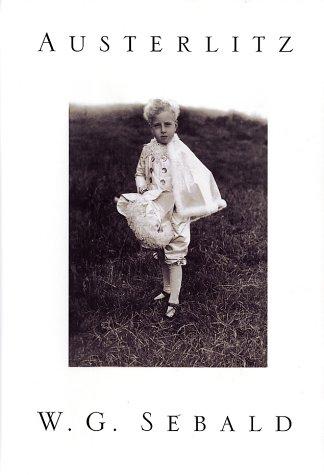
Austerlitz
W. G. Sebald · 1944–2001 · Germany / England
Originally Austerlitz (German) · translated by Anthea Bell
Why it matters
A man raised in Wales slowly uncovers the Kindertransport childhood taken from him: memory reassembled in train stations and archives. Sebald's only true novel and his masterpiece; published months before his death.
At a glance
Single sprawling sentences run for pages, nested within a frame narrator's retelling.
Deep dive
A novel built almost entirely out of other people's sentences relayed at second and third hand, and photographs presented as evidence that withhold exactly the one fact you want them to confirm.
Written for readers who have finished the book. No plot recap, and nothing here is safe to read first.
Themes & symbolism
Sebald makes grand architecture the novel's central image for repressed history: Austerlitz's professional obsession with the design of train stations, fortresses, and monumental public buildings long precedes his knowledge of his own past, as though his expertise in structures built for mass movement is a displaced, unconscious rehearsal for the fact he doesn't yet know — that he himself was moved, as a small child, out of danger and into a life with no record of where he came from. By the time he learns about the Kindertransport and his mother's deportation to Theresienstadt, the novel has already taught us to read stations and fortifications as monuments to loss disguised as monuments to transit and defense, so the revelation feels less like a twist than a confirmation of what the buildings were telling us all along.
The narration is doubled at every level — an unnamed narrator relaying, years later and from memory, what Austerlitz told him about his own recovered memories — and the prose enacts that remove formally, in long, winding, subordinate-clause sentences that circle a subject rather than advance directly toward it, mirroring how incompletely and indirectly this history can be retrieved. The uncaptioned photographs scattered through the text (station facades, documents, faces) are offered with the authority of archival evidence while remaining fundamentally ambiguous about what, exactly, they prove, which is the novel's argument in image form: documentation and testimony can gesture at a buried history without ever fully restoring it. That the two men keep meeting by chance, across decades and countries, rather than by arrangement, adds a further layer of indirection: even the friendship through which this history gets told is never quite under either man's control, arriving unbidden the way the buried past itself does.
The Camera Cannot Confirm
The cruelest photographic object in the book is the Nazi propaganda film shot at Theresienstadt to disguise the camp's real conditions — a document manufactured specifically to lie, which Austerlitz nonetheless searches, frame by frame, hoping to catch a glimpse of his mother's face. The novel's usual use of photographs as ambiguous-but-suggestive evidence curdles here into something closer to betrayal: the one visual record that might hold her image was built, by design, to falsify everything else it shows. Searching a lie for a fragment of truth is as close as the book comes to stating its thesis about the limits of historical recovery outright. It also reframes everything Austerlitz has done up to that point as a kind of professional preparation gone tragically literal: a man who has spent his career reading buildings for what they conceal about power and control finally has to read a film for what it was engineered to hide, and finds that his archival expertise, however rigorous, cannot force a fabricated record to yield an authentic fact.
The last seal: what actually happens, and why it lands the way it does.
The ending, explained
Austerlitz's research carries him to Theresienstadt and into that propaganda film, scanning it inconclusively for his mother without ever securing a confirmed account of her fate; his father's disappearance in Paris is left even less resolved. The novel ends with Austerlitz setting out for Paris to keep searching, guided partly by notes the narrator has been compiling on his behalf — an ending built on continuation rather than discovery. Sebald refuses closure on principle: the novel's argument is that the Holocaust's erasures cannot be fully recovered no matter how patient or thorough the search, so stopping mid-search is the only honest place to end.