
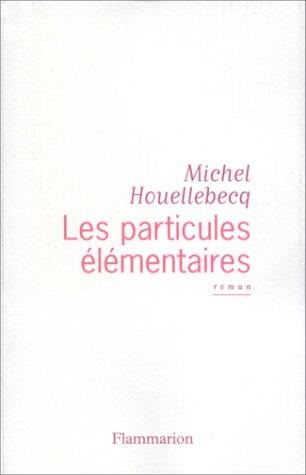
The Elementary Particles
Michel Houellebecq · b. 1956 · France
Originally Les Particules élémentaires (French) · translated by Frank Wynne
Why it matters
Two half-brothers (one enslaved to sex, one to science) chart the exhaustion of late-twentieth-century desire toward a genetically engineered posthuman future. Houellebecq's breakthrough novel of clinical despair and dark comedy.
At a glance
Clinical, essayistic digressions on science and sex interrupt otherwise plain narrative prose.
Deep dive
Two half-brothers built out of the same exhausted decade as opposite responses to it — one addicted to sex, one nearly incapable of desire — and the question of what, exactly, their mother's absence is supposed to explain.
Written for readers who have finished the book. No plot recap, and nothing here is safe to read first.
Themes & symbolism
Bruno and Michel read as split halves of a single case study in post-1968 exhaustion. Bruno's compulsive pursuit of sex isn't vitality but its opposite — a body that has fully internalized the marketplace logic of desirability and can find no exit from constant, humiliating competition for attention. Michel's near-total absence of desire, his retreat into molecular biology, looks like the healthy alternative but is really the same dead end from the other direction: abstraction standing in for eros rather than answering it. Their mother Janine, a hippie who abandoned both sons to chase the sexual revolution's promises of communal liberation, is the novel's real indictment — Houellebecq treats 1960s liberation ideology as a project that freed desire for the young and beautiful while quietly discarding everyone else, the boys themselves included.
The novel's flat, clinical narrating voice — closer to a research report than a novel, footnoted and mock-scientific — is itself thematic, treating tenderness and cruelty as equivalent data points and thereby enacting the very desolation it diagnoses. Christiane gives Bruno's chapters their one real current of feeling, and the cruelest lesson the book extracts from her decline is that even a love that briefly, functionally works cannot survive a body's collapse in a culture that has abolished any place for the old, the plain, or the disabled.
The Posthuman Narrator
The novel is narrated retrospectively by a member of the genetically engineered species that eventually replaces Homo sapiens, addressing the reader as a curious, faintly pitying relic of the species that came before. This framing device is where Houellebecq's clinical prose earns its purpose: the whole book turns out to be an anthropological report on humanity's final, self-inflicted era, which recasts Bruno's and Michel's private miseries as specimens in a case file rather than merely two sad lives.
The last seal: what actually happens, and why it lands the way it does.
The ending, explained
Michel's theoretical work in molecular biology becomes, after his disappearance in Ireland — presumed a suicide by drowning, his body never recovered — the foundation other scientists use to engineer a stable, asexual, effectively immortal successor species. The posthuman narrator explains that humanity, faced with the choice, opted collectively to replace itself rather than reform, and faded out without violence, "a species that did not deserve to survive, and did not particularly want to." Bruno, institutionalized after Christiane's death, is left as the human cost the epilogue's calm tone glides past: proof that the new species' peace was bought with exactly the suffering the old one never solved.
Where to go next
 Michel Houellebecq · 2015SubmissionLvl 4Medium pace
 Patrick Modiano · 1978Missing PersonLvl 5Medium pace
 J. M. G. Le Clézio · 1980DesertLvl 5Slow burn
 Georgi Gospodinov · 2020Time ShelterLvl 6Medium pace
 Vladimir Sorokin · 2006Day of the OprichnikLvl 5Fast paced
 Raymond Queneau · 1959Zazie in the MetroLvl 5Fast paced