
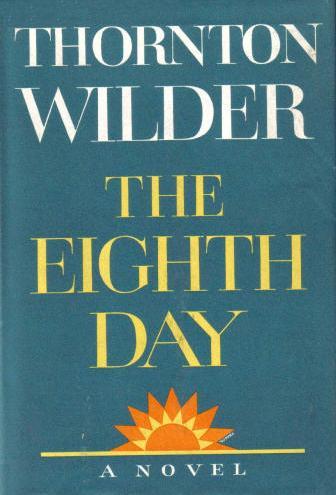
The Eighth Day
Thornton Wilder · 1897–1975 · United States
Why it matters
A man wrongly convicted of murder flees an Illinois mining town in 1902, and the mystery unravels backward across generations and continents. Wilder's late, sprawling National Book Award winner returns to his lifelong question of whether any life carries hidden pattern or meaning.
At a glance
A large cast and a backward-unwinding, multi-continent structure demand patience.
Deep dive
How a wrongful murder conviction in a small Illinois mining town becomes the occasion for Wilder to trace two families' histories backward across generations and continents — and what the title's biblical arithmetic has to do with the shape of a single human life.
Written for readers who have finished the book. No plot recap, and nothing here is safe to read first.
Themes & symbolism
John Ashley's conviction and escape are less the novel's real subject than its pretext: once he vanishes into flight, Wilder pulls the camera back and back again, unspooling the Ashley and Lansing family histories — courtships, migrations, ambitions realized and abandoned — until the fatal event that opens the book comes to look less like a discrete crime with a single culprit and more like the visible tip of an enormous, mostly submerged structure of inherited character, coincidence, and consequence. The title's allusion to Genesis is the key: if God rested on the seventh day, humanity's ongoing self-creation is the unfinished eighth, and Wilder keeps insisting that no single life is legible in isolation — you only see what a person was for once you've traced the whole web of lives that produced and depend on them.
That structural argument is also a moral one. The Ashley children left behind — Lily, who becomes a singer under a stage name; Roger, who becomes a journalist; the rest making their own quiet, hard-won recoveries from a scandal not of their making — thrive in spite of, and sometimes because of, the very disaster that seemed to end their father's story, which is Wilder's case for reading catastrophe itself as generative rather than merely destructive: pattern emerging from wreckage, if you're patient enough to trace it across enough years and enough people.
One Bridge, One Web
This was Wilder's last novel, and it returns forty years later to the structural idea that made his name: The Bridge of San Luis Rey opens with a catastrophe — a bridge collapsing, killing five strangers — and spends the rest of its length reconstructing each victim's hidden history to ask whether their deaths, and their lives, add up to a pattern or a purely arbitrary accident. The Eighth Day asks the same question at far greater length and geographic scope, tracing Ashley's flight from Illinois through South America alongside generations of family history on both sides of the crime, as though Wilder needed one more, larger attempt at the same lifelong problem before he was done writing novels at all.
That recurring architecture — catastrophe first, meaning assembled backward out of everyone connected to it — reflects a biography as internationally minded as its fiction: Wilder spent part of his childhood in China with a missionary father, moved fluidly between Yale, Princeton, and the Roman classical models he loved, and built a career, from Our Town's bare stage and fourth-wall-breaking Stage Manager onward, out of finding the cosmic scale hidden inside small, particular lives. The Eighth Day won Wilder the National Book Award in 1968, a late honor for a writer whose reputation had always rested more on his plays and on Bridge than on his novels generally.
The last seal: what actually happens, and why it lands the way it does.
The ending, explained
Wilder is deliberately more interested in pattern than in solving a mystery, and the novel resists handing over a clean whodunit even as it circles back toward the fatal shooting that started everything: the precise mechanics of who fired the gun, and under what mix of accident, provocation, and old grievance, emerge only gradually and only partially, refracted through the accumulated weight of both families' histories rather than delivered as a single clean revelation. That refusal is the point rather than a withheld payoff — Wilder is arguing that guilt and innocence, tidy as legal categories, are the wrong frame entirely for an event this deeply entangled in generations of other people's choices.
What the novel does resolve clearly is its thematic argument: Ashley's exile, his family's endurance and eventual flourishing, and the vast genealogical excavation the book undertakes to explain a single gunshot all serve the same idea Wilder had been circling since The Bridge of San Luis Rey — that any one life only becomes readable against the enormous, mostly invisible pattern of the lives that made it, and that the human project of finding meaning in that pattern is still, on this late and unfinished eighth day, very much underway.
Where to go next
 Thornton Wilder · 1927The Bridge of San Luis ReyLvl 4Medium pace
 Pearl S. Buck · 1931The Good EarthLvl 3Medium pace
 Charles Johnson · 1990Middle PassageLvl 5Fast paced
 Marguerite Yourcenar · 1951Memoirs of HadrianLvl 6Slow burn
 Wallace Stegner · 1971Angle of ReposeLvl 6Medium pace
 Edward P. Jones · 2003The Known WorldLvl 6Slow burn