
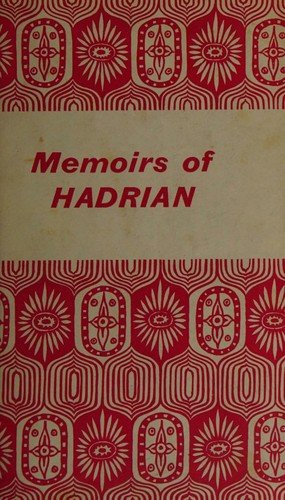
Memoirs of Hadrian
Marguerite Yourcenar · 1903–1987 · France / Belgium
Originally Mémoires d'Hadrien (French) · translated by Grace Frick
Why it matters
The Roman emperor narrates his own life, from military ambition to the love that broke him, in a dying letter to his successor. Historical fiction as total, meticulously researched empathy, rarely equaled since.
At a glance
Formal, meditative epistolary style demands sustained attention over momentum.
Deep dive
A dying emperor writes his successor the truth about power, at last honest because there's finally nothing left to gain by lying.
Written for readers who have finished the book. No plot recap, and nothing here is safe to read first.
Themes & symbolism
Yourcenar frames the entire novel as a letter from the dying Hadrian to his adopted grandson and eventual successor Marcus Aurelius, a device that makes the book's retrospective wisdom inseparable from its circumstance: Hadrian can afford total candor about ambition, cruelty, and desire precisely because death has removed every incentive to perform virtue or hide failure, and the novel's famous serenity of tone is less philosophical detachment than the specific freedom of a man with nothing left to lose by telling the truth.
Hadrian's grief over Antinous — the young man he loved, who drowned in the Nile under circumstances the emperor never fully explains even to himself, possibly a ritual self-sacrifice meant to extend Hadrian's own life through some Egyptian rite Hadrian only half-believed in — sits at the emotional center of a book otherwise devoted to statecraft, and Yourcenar uses the loss to complicate Hadrian's Stoic self-mastery: an emperor who prided himself on rational governance of both empire and self is left, after Antinous's death, deifying a dead lover across the Mediterranean world in a grief he can neither rationalize nor set aside, proof that even the most disciplined mind doesn't fully master what it loves.
Hadrian's peacetime consolidation of empire — walls, administrative reform, an end to Trajan's expansionist wars, deliberate cultivation of Greek philosophy and art over Roman militarism — reflects Yourcenar's own argument about civilization as a fragile, actively maintained achievement rather than a natural state: Hadrian understands, and says so directly to his successor, that everything he's built could unravel under a lesser or crueler ruler, and the memoir's real purpose, beneath its confessional intimacy, is a practical education in how power should be exercised by someone who has come to believe, hard-won, that restraint is a harder discipline than conquest.
Thirty Years to Find a Voice
Yourcenar began research toward this novel in her twenties, abandoned several attempts she later destroyed, and only found the book's voice in her forties after rediscovering an old draft that began, simply, 'I begin to see the shape of my death' — a first line close to the finished novel's own opening meditation on mortality. The finished text is built from decades of immersion in Roman history, epigraphy, and Hadrian's own surviving fragments and monuments (the Pantheon, his villa at Tivoli, his poem to his own departing soul), and Yourcenar's afterword lays out her method explicitly: total historical fidelity to known fact, with imaginative reconstruction reserved strictly for the psychological interior no document could ever supply. The result reads less like historical fiction performing period detail than like an act of genuinely disciplined empathy across two millennia.
The last seal: what actually happens, and why it lands the way it does.
The ending, explained
Dying slowly of heart failure and dropsy, having already secured the succession by adopting Antoninus on the condition that Antoninus adopt the young Marcus Aurelius in turn, Hadrian spends the memoir's final pages settling accounts rather than fighting his death: he reflects on a botched, humiliating attempt at assisted suicide his freedman refused to help him complete, on the executions and failures he can no longer excuse away, and on the strange privilege of dying in full possession of his faculties, with time enough to actually think about it. The novel closes not on a death scene but on Hadrian's own resolve to face what's coming with his eyes open, framed as the last and hardest task of a lifelong philosophy of rational self-governance — Yourcenar ends the book at the threshold rather than past it, because the point was never the death itself but the clarity Hadrian earns in approaching it.
Where to go next
 Marguerite Yourcenar · 1968The AbyssLvl 7Slow burn
 Jean-Paul Sartre · 1938NauseaLvl 6Slow burn
 Georges Bernanos · 1936Diary of a Country PriestLvl 6Slow burn
 André Gide · 1902The ImmoralistLvl 5Medium pace
 J. M. G. Le Clézio · 1980DesertLvl 5Slow burn
 Joris-Karl Huysmans · 1884Against Nature (À rebours)Lvl 7Slow burn