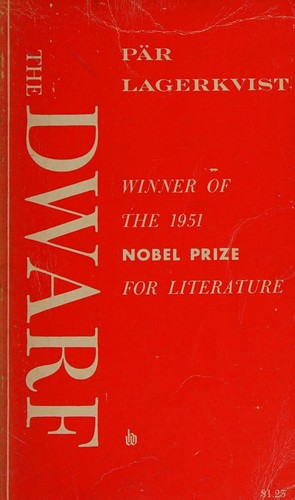
The Dwarf
Pär Lagerkvist · 1891–1974 · Sweden
Originally Dvärgen (Swedish)
Why it matters
A Renaissance prince's court dwarf narrates the poisonings and wars he engineers with cold relish. Lagerkvist's chilling allegory of fascism, voiced by a creature convinced that cruelty is simply clear sight.
At a glance
A compact, lucid first-person confession, dense with menace rather than syntax.
Deep dive
A twenty-six-inch court dwarf serves a Renaissance Italian prince as confidant and killer, and insists the whole time that he, not the humans around him, is the only fully honest creature in the palace.
Written for readers who have finished the book. No plot recap, and nothing here is safe to read first.
Themes & symbolism
The narrator opens by boasting of his own perfect twenty-six-inch proportions, unlike the misshapen dwarfs he despises, and of his standing as the Prince's most trusted confidant in an unnamed Italian court that plays out the whole grammar of Machiavelli's world, poisonings, marriages arranged for advantage, wars fought over territory barely larger than the city itself. Lagerkvist gives him a chilling self-theory almost immediately: that all dwarfs share one ancient, unchanging nature passed down since the beginning of the world, and that he alone, among the court's various diminished and deformed servants, is the genuine article rather than a debased copy.
His usefulness to the Prince is never affection, it is capacity: he strangles the Princess's cat without hesitation, poisons an enemy at his master's word, and volunteers for the court's ugliest tasks with an eagerness the Prince finds convenient and everyone else finds unspeakable. Lagerkvist is careful never to let the dwarf perform these acts as compulsion or madness; he narrates each one with the same flat, satisfied precision he gives his own proportions, cruelty presented as competence rather than as aberration.
When plague reaches the city partway through the novel, panicking a court that has spent the whole book treating violence as something it can direct and contain, the dwarf watches with something close to pleasure, recognizing in the epidemic's indifferent, unstoppable spread a larger version of the same force he embodies at human scale. Lagerkvist uses the plague to widen the dwarf from a single court's convenient monster into a stand-in for cruelty and destruction as conditions of existence itself, present in the world before any particular prince or war and certain to outlast them.
An Allegory Written in Neutral Sweden, 1944
Lagerkvist published The Dwarf in 1944, from a Sweden that had stayed formally neutral while the rest of Europe fought the war the dwarf's court violence keeps prefiguring, and readers at the time had little trouble reading the book as a diagnosis of fascism rather than a costume drama about the Italian Renaissance. It marked Lagerkvist's decisive turn from the poetry and expressionist drama of his early career toward the short, allegorical prose fables, The Sibyl, Barabbas, that would define his later reputation and lead to the Nobel Prize in 1951; the dwarf's insistence that his own cruelty is ancient and species-wide rather than personal reads as Lagerkvist's clearest statement of the argument those later books keep returning to.
The last seal: what actually happens, and why it lands the way it does.
The ending, explained
As the court's wars and the plague both subside, the Prince has the dwarf locked away in a cellar, less as punishment than as a precaution, a dangerous instrument put back into storage once its immediate usefulness has passed. Rather than any reckoning or remorse, the dwarf's final reflections insist on his own permanence: dwarfs like him have always existed at the edges of human power, indispensable and unloved, and will go on existing under whichever prince or system replaces this one, since the cruelty he embodies was never a property of this particular court to begin with. Lagerkvist denies the novel any purgative ending, the monster isn't destroyed, only shelved, still certain of his own eternity.