
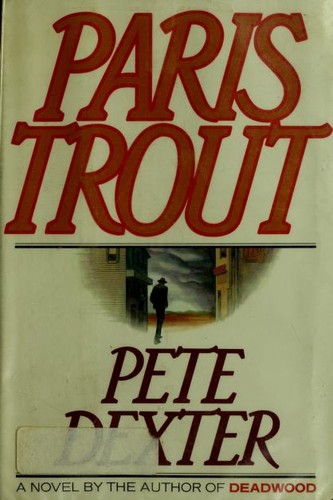
Paris Trout
Pete Dexter · b. 1943 · United States
Why it matters
A respected Georgia store owner's murder of a young Black woman exposes the moral rot beneath a small town's genteel 1950s surface as the ensuing trial slowly unravels. Dexter's National Book Award winner indicts complicity as much as the crime itself.
At a glance
Plain, journalistic prose keeps a disturbing plot moving at a brisk clip.
Deep dive
A killing the town's legal system treats as barely worth punishing sets off a second, private reckoning that the law had nothing to do with.
Written for readers who have finished the book. No plot recap, and nothing here is safe to read first.
Themes & symbolism
Trout's murder of Rosie Sayers is staged as almost administrative in his own mind — he conflates debt, ownership, and moral order so completely that harming someone who supposedly owes him money doesn't register as violence, only as collection. The town's legal system obliges that logic: his acquittal and eventual diminished-capacity ruling, rather than prison, exposes Jim Crow justice's actual function in Cotton Point as protecting white property and status rather than delivering truth. Dexter doesn't play this as an anomaly or a failure of the system — it's the system working exactly as designed, which is what makes Trout's later, more literal unraveling read as continuation rather than aberration.
Hanna Trout's arc from passive, terrorized wife to survivor is the novel's real center of gravity. Her domestic imprisonment under Paris mirrors the town's own captivity to the deference automatically extended to a white man of his standing, and her affair with Harry Seagraves — the very lawyer whose maneuvering helped free her husband — is a bitter irony that implicates the whole respectable legal establishment in her suffering, not just her husband's derangement. The novel is careful never to let Hanna's eventual escape feel like the system correcting itself; it corrects nothing, she simply survives it.
Dexter's flat, unadorned prose style refuses melodrama at every turn that a lesser novel would have reached for it, describing Trout's atrocities and the town's complicity in the same understated register it uses for weather and store inventory. That flatness is itself an indictment: violence this calmly narrated is violence the town has had a great deal of practice absorbing without comment, and the reader's own discomfort at how undramatically the worst events are delivered becomes part of what the novel is arguing about a community fluent in looking away.
Madness as Confirmation, Not Departure
Dexter refuses to treat Trout's escalating psychosis as a break from the racism that enabled his first crime — it's confirmation of a mind that was never restrained by anything except social permission. Once that permission, the town's automatic deference, starts eroding along with his sanity, the violence simply turns inward toward his own household, since Hanna is the only remaining target close enough to punish for a world that's stopped indulging him. His madness isn't a separate diagnosis from his racism; it's the same untethered entitlement with nowhere else left to go.
The last seal: what actually happens, and why it lands the way it does.
The ending, explained
After being found not guilty by reason of diminished capacity — a ruling that spares him prison while formally excusing what a Black victim's death could never otherwise excuse — Trout is committed to a state asylum. He escapes, returns home, and in a final unraveling that completes what the trial exposed, kills his mother-in-law and gravely wounds Hanna, who then shoots him dead in self-defense. The killing that opened the book, met with legal indifference because its victim was Black, is answered in the end only by another killing entirely outside the law — Dexter's bleakest possible verdict on a justice system that produced elaborate process for one death and nothing at all for the other.
Where to go next
 Leonardo Sciascia · 1961The Day of the OwlLvl 4Fast paced
 Suzanne Berne · 1997A Crime in the NeighborhoodLvl 4Medium pace
 Truman Capote · 1966In Cold BloodLvl 5Fast paced
 Patricia Highsmith · 1955The Talented Mr. RipleyLvl 4Fast paced
 Robert Stone · 1974Dog SoldiersLvl 6Fast paced
 Ann Patchett · 2001Bel CantoLvl 3Medium pace