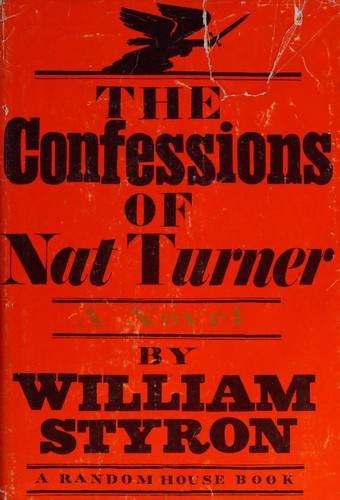
The Confessions of Nat Turner
William Styron · 1925–2006 · United States
Why it matters
Styron ventriloquizes the leader of an 1831 Virginia slave rebellion awaiting execution, reconstructing his interior life from a handful of historical fragments. Pulitzer-winning and fiercely controversial for its imaginative reach.
At a glance
A single dense first-person confession moving between memory and present-tense dread.
Deep dive
A white Southern novelist's imagined first-person voice for a real 1831 slave rebellion leader — and the argument it set off about who gets to narrate whom.
Written for readers who have finished the book. No plot recap, and nothing here is safe to read first.
Themes & symbolism
Styron builds the novel as an extended, invented confession spoken by Turner to the white lawyer Thomas Gray while awaiting execution, using the historical fact that a real (much shorter, more contested) confessions document exists as license to imagine an interior life for Turner that the actual historical record can't supply. Turner's visions and sense of divine calling are treated with genuine seriousness rather than pathologized, but Styron is equally interested in the gap between the mission Turner believes he's been given and the actual, uncontrollable violence of the rebellion once it begins — a disproportion Turner himself struggles, in his own account, to fully reconcile.
The novel's most contested material is Turner's fixation on Margaret Whitehead, the one victim he kills with his own hands during the uprising and the only one he describes with anything like tenderness or unresolved longing beforehand — Styron reads Turner's violence toward her as entangled with a suppressed desire he can't name even to himself, a psychosexual interpretation entirely invented rather than drawn from any historical source, and one that black critics singled out as a particularly damaging act of imaginative appropriation, projecting a white author's assumptions onto a Black revolutionary's inner life.
Styron's Turner is haunted less by doubt about the rebellion's justice than by its cost in bodies he didn't intend or sanction — the killing spreads past his control once other enslaved men join in, and the novel is candid about how quickly a righteous uprising becomes indiscriminate, which some readers took as a serious meditation on the moral hazards of righteous violence and others took as Styron subtly undermining the legitimacy of the rebellion itself by making its architect flinch from what he set loose.
The Ten Black Writers Respond
The novel won the 1968 Pulitzer Prize and was a bestseller, but its publication also produced one of the most consequential literary controversies of the era: the essay collection William Styron's Nat Turner: Ten Black Writers Respond (1968) accused Styron of softening Turner's radicalism, inventing a demeaning sexual obsession with a white woman, and more broadly claiming a voice and a history that wasn't his to claim, regardless of the research behind it. The controversy became a foundational case study in debates about authorial authority over marginalized historical figures — still cited, decades later, whenever the question of who has standing to narrate whom resurfaces in American letters.
The last seal: what actually happens, and why it lands the way it does.
The ending, explained
The novel closes with Turner, captured after weeks in hiding following the rebellion's collapse, finishing his confession to Gray on the eve of his execution — not with certainty or triumph but with the killing of Margaret Whitehead still unresolved in his own conscience, the one act in the uprising he can't fold into the divine mission he otherwise still believes was real. Styron declines to grant Turner either full vindication or full remorse; the last pages sit inside his private uncertainty about whether what he did was God's will or simply violence that outran its own justification, and the hanging itself happens essentially offstage, reported rather than dramatized. The refusal to resolve Turner's conscience one way or the other is Styron's most defensible formal choice in a deeply contested book — an ending that keeps the moral weight on the reader rather than supplying an easy verdict.