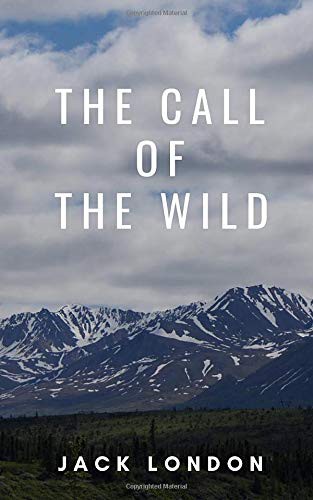
The Call of the Wild
Jack London · 1876–1916 · USA
Why it matters
A pampered California dog is stolen, sold into the brutal Yukon sled-dog trade, and sheds every trace of domestication until only ancestral wildness remains. London's Darwinian adventure fable made him famous at twenty-seven and became naturalism's most purely physical, most read book.
At a glance
Short, plainly told adventure narrative with a simple, linear plot.
Deep dive
What London's 'call' actually costs to answer, and why a dog story became the era's clearest argument for a Darwinian universe stripped of sentiment.
Written for readers who have finished the book. No plot recap, and nothing here is safe to read first.
Themes & symbolism
Buck's transformation is staged as a series of lessons in the law of club and fang: the man in the red sweater teaches him that force, not affection, is the operating principle of this world, and every owner afterward either confirms or briefly suspends that lesson. London structures the novel almost as a behaviorist experiment — strip away the domestication (regular meals, a soft bed, a master's whims) and watch the buried instincts of Buck's wolf ancestors surface one degree at a time, from stealing food to killing for sport to, eventually, hunting moose in formation with a pack. The dream-visions of a hairy, fireside primeval man that visit Buck partway through aren't decoration; they're London's way of insisting that atavism runs all the way down, that civilization is a recent and reversible coat of paint over something much older and more honest.
The ambivalence critics still argue over is whether the book endorses this regression as liberation or mourns it as loss. London gives John Thornton's camp real warmth — the one relationship in the novel not organized around domination — and lets Buck feel something close to love there, which complicates the thesis that only atavistic instinct is real. But love, in this book, turns out to be exactly as conditional as civilization: it lasts only as long as the human tie does, and once that tie is severed the wild doesn't feel like tragedy to Buck at all. It feels like coming home.
Naturalism, Nietzsche, and London's Contradictions
London wrote this at twenty-seven, fresh off his own Klondike prospecting trip and already steeped in Spencer's social Darwinism and a garbled, enthusiastic reading of Nietzsche — the same intellectual soup that produced the era's naturalist fiction (Norris, Crane, Dreiser), where character is fate and biology outvotes free will. The irony is that London was simultaneously a committed socialist who believed collective action, not raw dominance, was humanity's future; The Call of the Wild reads almost like his unconscious working out an anxiety his politics couldn't fully answer — that underneath the solidarity he preached for, something older and more brutally individualist might still be running the show. He'd write the mirror-image story, White Fang, a few years later, walking a wild wolf-dog the other direction into domestication, as if trying to prove the process wasn't fatal after all.
The last seal: what actually happens, and why it lands the way it does.
The ending, explained
Thornton's death is what finally severs Buck completely: while Buck is off answering the call on an exploratory run into the timber, Yeehat hunters kill Thornton and his men for their supplies, and by the time Buck returns there's nothing human left to hold him. He kills several of the Yeehats in retaliation — the novel's clearest moment of the wild used in service of an almost-human loyalty — and then, with no further reason to stay, joins a wolf pack outright, becoming its leader. London closes not on Buck's death or disappearance but on his apotheosis: he becomes a local legend, a huge wolf-like 'Ghost Dog' the Yeehats fear and avoid, seen only at a distance, who returns every year to the valley where Thornton died to mourn briefly before vanishing again into the pack. It's a rare ending for the era in that nothing is punished or redeemed — the wild simply, finally, wins, and the novel treats that as neither happy nor sad but inevitable.