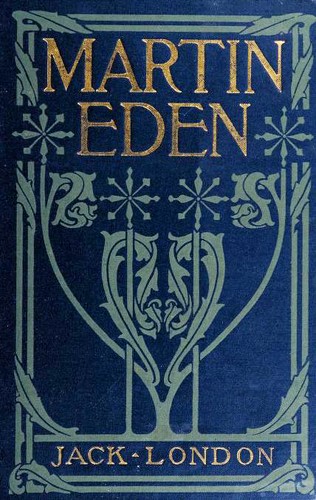
Martin Eden
Jack London · 1876–1916 · USA
Why it matters
A self-taught sailor claws his way from poverty to literary fame chasing a woman above his class, then discovers success has hollowed him out entirely. London's bitterest, most autobiographical novel follows raw individualism all the way to its bleakest possible conclusion.
At a glance
Straightforward narration, though embedded philosophical debates about socialism and individualism slow the plot.
Deep dive
How far raw self-invention can carry a man who claws his way out of the California waterfront into literary fame, and what happens to his appetite for life once every goal he set himself has actually been reached.
Written for readers who have finished the book. No plot recap, and nothing here is safe to read first.
Themes & symbolism
Martin Eden begins as an uneducated sailor who wanders into the Morse family's Oakland parlor, falls for Ruth Morse on sight, and decides on the spot to remake himself into someone her class could accept: he teaches himself grammar, philosophy, and literary craft in a punishing self-directed curriculum, selling nothing for years while starving in a rented room and writing fiction nobody will buy. London, who lived roughly this life before he lived Martin's fame, gives the early chapters an autobiographical exactness that most bildungsromans about self-made writers can't match: the library card schemes, the pawnshop trips, the arithmetic of how many hours of sleep a manuscript is worth.
Russ Brissenden, a dying poet Martin meets late in his apprenticeship, supplies the novel's philosophical spine and its warning: Brissenden is a genuine talent who has already burned through the illusions Martin is still chasing, preaching a Nietzschean individualism and a Herbert Spencer materialism that Martin absorbs completely, while Brissenden himself keeps insisting that success, when it finally comes, will prove worthless. Martin argues with him for two hundred pages and then lives out every one of Brissenden's predictions almost exactly, which is the novel's cruelest structural joke: the warning was never subtle, and Martin heard it clearly, and it changed nothing.
Ruth Morse and the Class Ruth Never Leaves
Ruth loves the idea of Martin more comfortably than she loves the actual sailor in front of her, breaking their engagement the moment his radical opinions and unsold manuscripts threaten her family's respectability, then reappearing, uninvited, the day the magazines finally start paying. London refuses to soften her into a villain: she is simply, consistently, a product of the class Martin worked so hard to enter, and her return proves to Martin, more completely than any of Brissenden's lectures could, that the acceptance he'd spent years chasing was never really about him at all.
The last seal: what actually happens, and why it lands the way it does.
The ending, explained
Fame arrives all at once: the same publishers who rejected Martin for years buy everything he wrote in his hungry period, Ruth comes back asking to resume the engagement, and Martin discovers that neither the money nor her renewed love means anything now that he no longer needs either. He gives money away, drifts through his own success as a spectator, and eventually books passage on a ship south, still trying to outrun the emptiness rather than name it. Alone in his cabin, worn down past the point of wanting the next day, Martin lowers himself out of a porthole into the sea and lets himself sink, a death London wrote four years before his own disputed end was rumored, in some accounts, to echo it.