
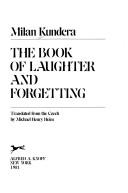
The Book of Laughter and Forgetting
Milan Kundera · 1929–2023 · Czechia / France
Originally Kniha Smíchu a Zapomnění (Czech)
Why it matters
Seven variations on erasure (of photographs, lovers, and countries) in the key of Czech irony. Written in exile, it cost Kundera his citizenship; 'the struggle of man against power is the struggle of memory against forgetting.'
At a glance
A fragmented set of loosely linked variations rather than a single plot, unified by theme alone.
Deep dive
Seven variations on losing a photograph, a lover, a country, and a citizenship, built around Kundera's claim that forgetting is always a form of power.
Written for readers who have finished the book. No plot recap, and nothing here is safe to read first.
Themes & symbolism
Kundera opens with a real, doctored photograph: in February 1948, Klement Gottwald addressed a crowd from a Prague balcony bare-headed in the cold, so fellow Communist Vladimir Clementis lent him his own fur hat; four years later, after Clementis was tried and hanged, the propaganda office airbrushed him out of the official photograph entirely, leaving only his hat, now unexplained, on Gottwald's head. That single image gives Kundera his structuring claim across all seven parts: 'the struggle of man against power is the struggle of memory against forgetting,' argued through political history and private life at once.
Mirek, in the opening variation, tries to erase his own compromising past by recovering old love letters, only to have the state seize them as evidence against him the moment he goes looking, erasure attempted from below meeting erasure imposed from above. Tamina, a grief-stricken emigre café waitress who anchors the fourth and sixth variations, is trying to retrieve her dead husband's letters and diaries left behind in occupied Prague, convinced that without the documents she will lose her only accurate memory of him, a private, non-political version of the same struggle the book keeps restaging at national scale.
Kundera also names and defines litost, a specifically Czech emotion he glosses as torment at the sudden, witnessed sight of one's own inadequacy, developed at length through a student poet's affair with Kristyna in the fifth variation, and repeatedly breaks the fictional frame to address the reader directly about the book's own method, which is part of why he insists, in the subtitle, that this is a novel rather than a set of unrelated stories.
Angels' Laughter Against Devils' Laughter
Kundera distinguishes two kinds of laughter across the book: an angel's laughter affirms that the world has meaning and order, the circle dance of celebrating Czechs literally rising off the ground in one recurring image, while a devil's laughter mocks that same claim to meaning and empties it out. Kundera stages both across the book's variations, including his own recollection of dancing in a circle with fellow writers shortly before the state stripped his citizenship, refusing to let either kind of laughter simply win.
Kundera Writes Himself Into the Book
Unlike a conventional story collection, the narrator repeatedly identifies himself as Kundera, commenting directly on Tamina's situation, on litost, on why he has arranged the book as variations rather than a continuous plot. That authorial presence, recurring across parts with no shared cast, is what he means by calling the book a novel: not a single story carried through to a resolution, but one argument carried through seven different demonstrations.
The last seal: what actually happens, and why it lands the way it does.
The ending, explained
The final variation, 'The Border,' follows Jan toward a seaside colony where nudity has become compulsory leisure rather than transgression, and his relationship with Edwige, who receives every one of his private ironies as sincere feminist affirmation and never once hears the joke underneath. The border of the title is the line past which a word, a gesture, or a body stops carrying any meaning at all, purely present and purely empty, the same border Tamina reaches on the children's island in the sixth variation, where the games around her have no stakes and no memory attaches to anything: Kundera leaves it unresolved whether she reaches the shore trying to swim free of it or drowns in the attempt. Both endings land on the same argument: forgetting is not only something power does to a population's history, it is also a state a person can be driven into, or finally choose, once meaning itself gives out.
Where to go next
 Milan Kundera · 1984The Unbearable Lightness of BeingLvl 5Slow burn
 Bohumil Hrabal · 1976Too Loud a SolitudeLvl 6Slow burn
 Franz Kafka · 1915The MetamorphosisLvl 4Medium pace
 Robert Musil · 1906Young TörlessLvl 6Medium pace
 Witold Gombrowicz · 1937FerdydurkeLvl 7Fast paced
 Gabriel García Márquez · 1967One Hundred Years of SolitudeLvl 6Medium pace