
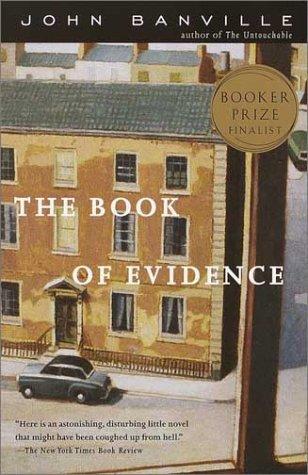
The Book of Evidence
John Banville · b. 1945 · Ireland
Why it matters
An idle, cultured man confesses to a stupid, brutal murder committed almost as an afterthought, and can only account for it through his own dazzling prose. Banville's breakthrough study of aesthetic self-regard curdled into monstrosity.
At a glance
Ornate, self-conscious first-person prose from a narrator who revels in evasion.
Deep dive
Why a man on trial for beating a housemaid to death spends most of his own confession describing a painting instead of her, and what that tells you about the crime he is actually guilty of.
Written for readers who have finished the book. No plot recap, and nothing here is safe to read first.
Themes & symbolism
Freddie Montgomery narrates his own trial in the present tense, and the confession he produces is less an account of killing Josie Bell than a defense of his own sensibility, delivered in prose so poised it starts to look like the crime's real motive. He can reconstruct, brushstroke by brushstroke, the face of the woman in the stolen Dutch portrait he was trying to steal when Josie interrupted him, but her own face keeps slipping out of focus in his telling, a blank he never manages to fill even under oath. Banville's argument is that Freddie's crime was never really the theft or even the killing; it is a lifelong failure to grant another person the same reality he grants a painted one.
The novel is loosely built from an actual Irish case, the 1982 killing carried out by Malcolm MacArthur, whose arrest inside the Attorney General's own flat became a national scandal known by the acronym GUBU, grotesque, unbelievable, bizarre, unprecedented. Banville strips away the political farce and keeps only the interior weather, Freddie's scientific training supplying him with a vocabulary of precise observation that he turns on himself with the same cool detachment he once turned on specimens, evidence offered to a court that can measure his eloquence but not his guilt. Freddie's own motive circles the same triviality the case became famous for: gambling debts and a stalled research career on a Mediterranean island, not passion, are what send him back to Ireland looking for money, and a painting to sell, in the first place.
A Trial Freddie Is Winning as a Stylist and Losing as a Man
Every scene in the courtroom doubles as a performance review of Freddie's own prose: he notices when a phrase lands well, second-guesses an image, admires his own timing in withholding a detail, and the reader ends up assessing him the way an editor assesses a draft rather than the way a jury assesses a killer. That slippage is the book's real subject. Freddie has spent his whole life aestheticizing experience instead of living inside it, and the confession, for all its self-laceration, is one more instance of the exact habit that let him swing a hammer at a living woman he had already stopped being able to see as one. He even compares his own memory of the killing, blurred and reluctant to resolve into detail, to an underexposed photograph rather than to the finished portrait he can summon at will, reaching for an aesthetic category to describe a moral failure instead of naming the failure itself.
The last seal: what actually happens, and why it lands the way it does.
The ending, explained
Freddie is convicted, and the document the reader has been reading turns out to be the evidence of the title, his own written confession, composed in custody rather than delivered live in a courtroom. He arrives, late and without much comfort to himself, at the plainest possible account of what happened: he killed Josie Bell not from passion or greed but because she was in the way of the painting, an object he had already invested with more reality than he had ever managed to invest in another human being. The last note is not remorse so much as diagnosis, Freddie identifying, with the same cold precision he brought to everything else, the exact shape of his own moral blindness.
Where to go next
 John Banville · 2005The SeaLvl 6Slow burn
 Javier Marías · 1992A Heart So WhiteLvl 8Slow burn
 Friedrich Dürrenmatt · 1958The PledgeLvl 5Fast paced
 Elfriede Jelinek · 1983The Piano TeacherLvl 7Slow burn
 Julian Barnes · 2011The Sense of an EndingLvl 4Medium pace
 Graham Swift · 1996Last OrdersLvl 5Medium pace