
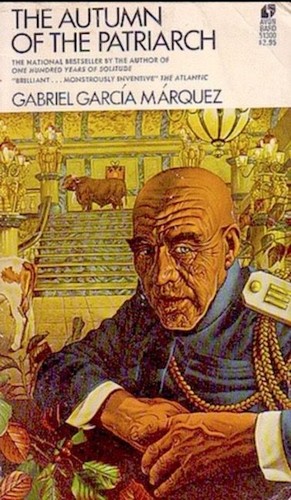
The Autumn of the Patriarch
Gabriel García Márquez · 1927–2014 · Colombia
Originally El otoño del patriarca (Spanish) · translated by Gregory Rabassa
Why it matters
A nameless dictator has reigned so long nobody remembers a world before him, his death narrated and re-narrated in torrential, near-punctuationless prose. García Márquez's most formally extreme book: power's rot rendered as fever dream.
At a glance
Chapter-long sentences shift narrators and timeframes without warning or paragraph breaks.
Deep dive
A dictator so total that his own country can only narrate him collectively, as a single unbroken we, and the novel's real subject is what that pronoun costs a nation forced to speak it for over a century.
Written for readers who have finished the book. No plot recap, and nothing here is safe to read first.
Themes & symbolism
García Márquez writes the entire book as run-on interior monologue with almost no full stops for pages at a time, voice sliding without warning between an anonymous collective we, the patriarch's own thoughts, and the perspectives of people who served or feared him. That instability isn't stylistic showing-off. It's the argument: absolute power dissolves the ordinary boundary between a ruler and the people he rules, so that his subjects can no longer describe him as a separate object, only as a condition they are all trapped inside together. Each of the novel's six unmarked sections opens on the same scene, officials finding his corpse in the palace, and then loops backward through decades of rule, so the book never moves toward his death so much as circles it, refusing him the dignity of a single, locatable ending.
The patriarch's mother, Bendición Alvarado, sells caged birds in the market before her son's rise and later gets posthumously canonized on his orders, painted into cathedral ceilings as a saint she never was. His decision to sell the Caribbean Sea itself to foreign creditors, and the arrival of ordinary domestic cows wandering the palace's marble halls because he never bothered to have them removed, work the same way: absurdity as an index of unaccountable power, where no idea is too grand or too petty to become official reality the moment he wants it to be true. Nothing in the country can push back on his whims because nothing in the country, including geography and biology, has been allowed to stay outside his authority.
A Composite Made from Every Real Caudillo
The patriarch is never named and never fixed to one nation, and García Márquez built him deliberately from a shelf of actual Latin American strongmen: Juan Vicente Gómez's decades-long, near-supernatural grip on Venezuela, Rafael Trujillo's Dominican Republic, Francisco Franco's Spain. The novel arrived in 1975 alongside a wave of dictator novels by other Boom writers, Augusto Roa Bastos's I the Supreme and Alejo Carpentier's Reasons of State among them, each responding to the same regional history from a different angle. García Márquez's contribution was to abandon a single ruler's biography almost entirely and write instead about what unlimited tenure does to language itself, to the pronouns and tenses a country has left for describing a man who has outlasted every possible witness to his rise.
The last seal: what actually happens, and why it lands the way it does.
The ending, explained
The novel opens and closes on the same discovery: soldiers finding the patriarch's body being eaten by vultures inside the palace, and only the sight of birds actually tearing at his flesh convinces anyone that he is truly dead, since he has faked or survived his own reported death so many times before that the population has stopped trusting any report short of physical evidence. Early in his reign he had already staged one death, letting a body double named Patricio Aragonés absorb an assassination meant for him. By the real end, decades later, the distinction between the man and the myth of his invincibility has worn so thin that his actual corpse needs scavenger birds to prove itself genuine. García Márquez ends on that grotesque confirmation rather than any dignified death scene, since dignity was never something the office had left for him to die with.
Where to go next
 Gabriel García Márquez · 1961No One Writes to the ColonelLvl 3Medium pace
 Gabriel García Márquez · 1967One Hundred Years of SolitudeLvl 6Medium pace
 Gabriel García Márquez · 1981Chronicle of a Death ForetoldLvl 5Fast paced
 Gabriel García Márquez · 1985Love in the Time of CholeraLvl 4Medium pace
 Gabriel García Márquez · 1994Of Love and Other DemonsLvl 5Medium pace
 Juan Rulfo · 1955Pedro PáramoLvl 7Slow burn