
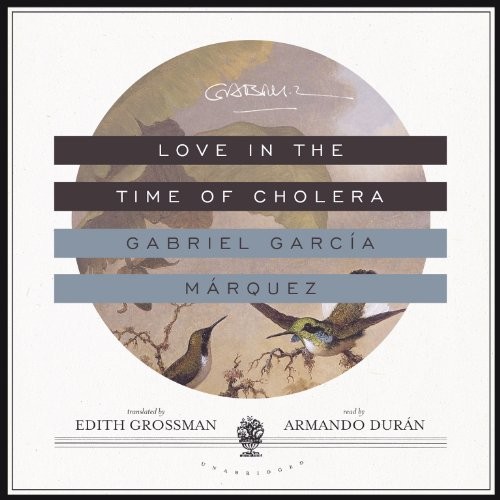
Love in the Time of Cholera
Gabriel García Márquez · 1927–2014 · Colombia
Originally El amor en los tiempos del cólera (Spanish) · translated by Edith Grossman
Why it matters
Fifty-one years, nine months, and four days of waiting: romantic persistence treated as both disease and grace. García Márquez after the Nobel, proving the magic worked on the human heart directly.
At a glance
A linear, lyrical love story told in warm, accessible prose despite its long span.
Deep dive
How more than fifty years of waiting gets treated as its own kind of chronic illness, and what García Márquez asks readers to forgive in the man who does the waiting.
Written for readers who have finished the book. No plot recap, and nothing here is safe to read first.
Themes & symbolism
García Márquez opens the novel with Dr. Juvenal Urbino investigating an apparent case of cholera and discovering instead the smell of bitter almonds from a suicide, and that confusion sets the terms for everything after: love here presents with the same fever, appetite loss, and delirium as the epidemic Urbino has spent his career fighting, and the novel takes the equivalence seriously rather than treating it as wordplay. Florentino Ariza's decades of devotion to Fermina Daza after she rejects him for Urbino aren't framed as noble patience so much as a chronic condition he never seeks treatment for, flaring and subsiding but never actually cured, right up until Urbino's own death finally clears space for a cure to become available.
Florentino's fidelity is also, pointedly, a lie: he keeps a ledger of 622 recorded liaisons across those same decades, and García Márquez refuses to let his hero's constancy of feeling excuse the damage some of that appetite causes, most sharply in his affair with his own young cousin and ward, América Vicuña, barely into adolescence when it begins. The novel doesn't editorialize against Florentino the way a more cautious book might, but it doesn't absolve him either: his single-minded pursuit of one woman across fifty-one years reads as devotion and as a kind of moral tunnel vision at once, capable of treating a teenager in his care as collateral to the same appetite that sustained his great love.
A Marriage the Novel Refuses to Call Second-Best
Fermina's marriage to Urbino begins as a calculated, faintly mercenary arrangement on both sides, her family's ambition and his social standing doing more of the courting than either party's feeling, and García Márquez spends the middle third of the book making the case that the affection they build across decades of shared bathrooms, arguments, and eventual tenderness is every bit as real as Florentino's undiluted longing, just built by different means. The novel's late insistence on that equivalence, one love made of waiting and imagination, the other of habit and accumulated intimacy, is what keeps it from simply crowning Florentino's romanticism as the truer form.
The Riverboat as the Novel's Real Argument
Cartagena's river trade and the Magdalena River itself, increasingly stripped of its forests and its manatees by decades of steamship traffic, run under the love story as a quiet historical clock: the same nineteenth-century world that shaped Fermina's and Florentino's courtship is visibly running out along with their youth. García Márquez keeps that ecological decline in view without moralizing about it directly, letting an old man's belated romance play out against a landscape dying at a comparable pace, so the novel's tenderness toward its two elderly lovers never fully separates from its awareness of everything else being lost around them.
The last seal: what actually happens, and why it lands the way it does.
The ending, explained
Once Urbino has fallen from a ladder chasing an escaped parrot and died from the fall, Florentino resumes his decades-old courtship of the newly widowed Fermina, and after a long, wary reacquaintance the two elderly lovers board one of Florentino's own riverboats, the New Fidelity, for a voyage up the Magdalena. When port authorities signal the boat to dock, Florentino has the captain raise the yellow cholera flag, a lie that clears the ship of other passengers and obligations by claiming a quarantine, and the boat simply keeps sailing back and forth along the river rather than ever landing. García Márquez ends the novel on that fabricated quarantine turned literal: two people in their seventies granted, through a small deception, exactly the unbounded, undying time together the entire book has been arguing love actually wants.
Where to go next
 Gabriel García Márquez · 1961No One Writes to the ColonelLvl 3Medium pace
 Gabriel García Márquez · 1967One Hundred Years of SolitudeLvl 6Medium pace
 Gabriel García Márquez · 1975The Autumn of the PatriarchLvl 9Slow burn
 Gabriel García Márquez · 1981Chronicle of a Death ForetoldLvl 5Fast paced
 Gabriel García Márquez · 1994Of Love and Other DemonsLvl 5Medium pace
 Juan Rulfo · 1955Pedro PáramoLvl 7Slow burn