
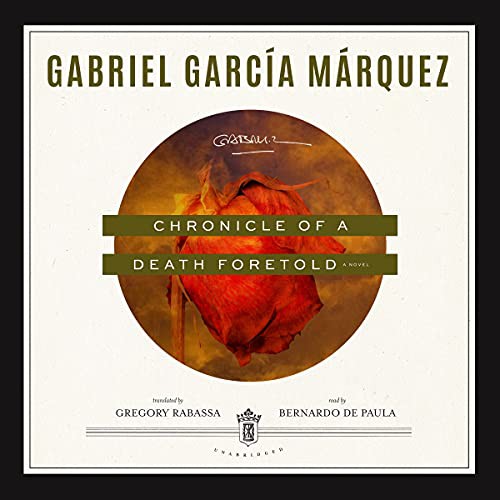
Chronicle of a Death Foretold
Gabriel García Márquez · 1927–2014 · Colombia
Originally Crónica de una muerte anunciada (Spanish) · translated by Gregory Rabassa
Why it matters
Everyone in town knows Santiago Nasar will be killed at dawn, and nobody stops it. A murder investigated like scripture: the whole town complicit, the reader too. His tightest, most perfect machine.
At a glance
A compact multi-perspective reconstruction requires piecing together a fragmented timeline.
Deep dive
Why a town spends an entire morning watching a foretold act of violence approach without anyone quite managing to stop it, and what García Márquez is really cross-examining once the outcome is no mystery at all.
Written for readers who have finished the book. No plot recap, and nothing here is safe to read first.
Themes & symbolism
Chronicle of a Death Foretold announces its outcome in its first line and keeps announcing it for the rest of the book, so García Márquez isn't building toward a revelation, he's cross-examining a town about why foreknowledge did nothing. The unnamed narrator returns to his hometown twenty-seven years later to reconstruct that single morning by interviewing whoever will still talk, and the prose adopts the procedural cadence of testimony and inquest rather than fable: times are logged to the minute, weather is noted, contradictory memories are set flatly against each other without being resolved. That documentary posture is the novel's real subject. It's modeled closely on an actual 1951 killing in Sucre, Colombia, and García Márquez writes it less as tragedy than as an inquiry into a communal failure of nerve.
Pedro and Pablo Vicario announce their intention to nearly everyone in town before they act, loudly and repeatedly, in the local butcher shop while sharpening the knives they've just used to gut pigs, and the novel's cruelest joke is how many people assume someone else will intervene. A cook forgets to mention it because she's absorbed in breakfast preparations; the mayor confiscates the knives once, then lets the twins re-arm; the priest is preoccupied with an incoming bishop; Santiago Nasar's own mother, trying to protect him, locks the door he would have needed to escape through. Angela Vicario's naming of Santiago as the man who took her virginity is never verified within the novel, and García Márquez lets that uncertainty stand permanently: the honor code that sets the twins in motion doesn't require proof, only accusation, and a town that mostly doubts the accusation still lets the machinery run to its foretold conclusion.
Sucre, 1951, and the Killing García Márquez Grew Up Next To
The novel is a close, barely disguised retelling of the killing of Cayetano Gentile Chimento, a friend of García Márquez's own family, killed in the town of Sucre after a broken engagement produced an accusation of lost virginity almost identical to Angela Vicario's. García Márquez was living in Paris when it happened and didn't write the story down for three decades, partly, he said later, out of respect for Gentile's mother, still alive when the novel appeared. The fictional distance he adds, an unnamed narrator, a shifted name, a compressed timeline, doesn't soften the material so much as let him interrogate the town's collective failure without simply accusing his own childhood neighbors by name.
A Structure Built Like an Inquest
Each chapter loops back over the same few hours from a new angle, a technique closer to a coroner's report or a court record than a conventional narrative, and the repetition does real work: instead of accumulating suspense toward an unknown event, it accumulates evidence of exactly how avoidable the whole thing was. Details recur with small variations, whose watch had the correct time, who actually warned whom, and the discrepancies are never tidied up. García Márquez uses the form of an investigation to arrive not at a verdict but at a diagnosis: a community capable of near-total advance knowledge and near-total inaction at once.
The last seal: what actually happens, and why it lands the way it does.
The ending, explained
Santiago Nasar dies in his own doorway, stabbed repeatedly by Pedro and Pablo Vicario with the same knives they'd been sharpening in public all morning, after his mother, trying to shield him, bars the front door he'd been running toward, forcing him instead back toward the twins waiting in the square. He staggers around to the back of the house holding in his own viscera before collapsing in the kitchen. The novel's final irony arrives in its coda: Angela Vicario, exiled by her family after the killing, spends decades writing hundreds of unanswered letters to Bayardo San Román, the husband who returned her on their wedding night, until he finally appears at her door as an old man carrying every one of them, unopened but kept. García Márquez lets that reunion stand as its own quiet rebuke to the honor code that started everything: the one relationship the town's violence was supposedly defending turns out to survive only once all of that violence is finished mattering to anyone.
Where to go next
 Gabriel García Márquez · 1961No One Writes to the ColonelLvl 3Medium pace
 Gabriel García Márquez · 1967One Hundred Years of SolitudeLvl 6Medium pace
 Gabriel García Márquez · 1975The Autumn of the PatriarchLvl 9Slow burn
 Gabriel García Márquez · 1985Love in the Time of CholeraLvl 4Medium pace
 Gabriel García Márquez · 1994Of Love and Other DemonsLvl 5Medium pace
 Juan Rulfo · 1955Pedro PáramoLvl 7Slow burn