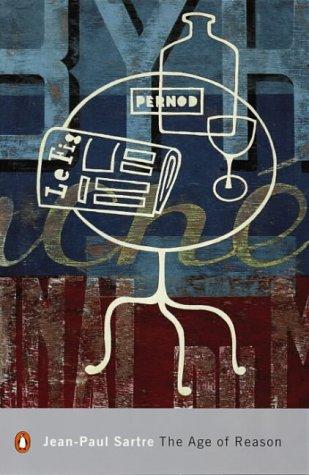
The Age of Reason
Jean-Paul Sartre · 1905–1980 · France
Originally L'Âge de raison (French)
Why it matters
A philosophy professor in 1938 Paris seeks money for his mistress's abortion while circling, and failing to act on, his own freedom. The opening volume of Sartre's Roads to Freedom trilogy stages existentialism as lived, hesitant crisis.
At a glance
Extended philosophical dialogue on freedom slows a single day's compressed plot.
Deep dive
Mathieu Delarue spends one frantic day trying to raise enough cash for an abortion, and Sartre uses the errand to ask whether a man who refuses every commitment is actually free or just avoiding the question.
Written for readers who have finished the book. No plot recap, and nothing here is safe to read first.
Themes & symbolism
Mathieu Delarue, a Paris philosophy teacher circling forty without ever quite arriving at it, spends the novel's central days trying to raise enough money for his mistress Marcelle's abortion, and Sartre turns the errand into a referendum on the freedom Mathieu has spent his whole adult life prizing above every other value. His brother Jacques, a comfortable bourgeois lawyer, offers to lend the money on the explicit condition that Mathieu marry Marcelle instead, a bargain Mathieu refuses less out of principle than out of a horror of being pinned down to any single, defining choice. Sartre had published Being and Nothingness two years earlier, and Mathieu's whole self-justifying account of his own liberty reads as a case study in what that book calls bad faith, mauvaise foi, the practiced trick of insisting a choice is impossible when it is merely one he does not want to make.
Ivich, the volatile, self-destructive young woman Mathieu is infatuated with, exposes the same pattern from the opposite angle: he wants her without ever committing to wanting her, keeping the relationship permanently provisional the same way he keeps everything else, his politics, his teaching, his own coming decision about Marcelle. Sartre sets the whole story in the summer of 1938, with the Spanish Civil War's refugees and the gathering Munich crisis pressing at the novel's edges, a world visibly running out of room for Mathieu's kind of endlessly deferred choice.
Daniel's Cruelty as a Kind of Commitment
Daniel, Mathieu's friend, carries a self-loathing rooted partly in a homosexuality he cannot accept in himself, and after an earlier, half-aborted attempt to drown his own cat out of pure self-punishing spite, he makes the novel's one genuinely decisive move: he proposes marriage to the pregnant Marcelle himself, not from love but from a wish to inflict on his own life the same contempt he already feels for it. Sartre uses Daniel's ugly, motivated decisiveness to sharpen what's actually wrong with Mathieu's paralysis, that keeping every option open isn't the same as being free, it's just another way of refusing to be anyone in particular.
The last seal: what actually happens, and why it lands the way it does.
The ending, explained
Having failed to raise the money any respectable way, Mathieu finally steals it from Lola, an aging cabaret singer and the lover of Ivich's brother Boris, taking cash from her hotel room while she lies unconscious after a suicide attempt earlier in the novel. He arrives at Marcelle's only to learn that Daniel has already proposed and been accepted, so the one real, transgressive action Mathieu manages across the entire book, theft, actually deciding something, accomplishes nothing at all. Sartre leaves him with the money now useless in his pocket and the recognition, not fully admitted but clearly staged, that the freedom he has spent years defending has mostly just been a freedom from consequence, a luxury the war closing in around the novel's final pages is about to take away from everyone.