
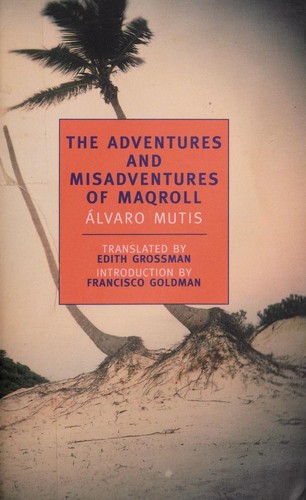
The Adventures and Misadventures of Maqroll
Álvaro Mutis · 1923–2013 · Colombia
Originally Empresas y tribulaciones de Maqroll el Gaviero (Spanish) · translated by Edith Grossman
Why it matters
Seven linked novellas follow a stateless, doomed merchant sailor across ports, failed schemes, and melancholic adventure. A modern Ulysses with nowhere left to go home to, from García Márquez's closest friend.
At a glance
Seven linked novellas roam widely, requiring the reader to assemble a scattered life.
Deep dive
Why Mutis built his most enduring character out of doomed enterprises and unfinished ports, and what seven novellas add up to when almost none of them behave like a conventional plot.
Written for readers who have finished the book. No plot recap, and nothing here is safe to read first.
Themes & symbolism
Maqroll el Gaviero, the Lookout, drifts across the seven novellas collected here (The Snow of the Admiral, Ilona Arrives with the Rain, Un Bel Morir, The Tramp Steamer's Last Port of Call, Amirbar, Abdul Bashur Dreamer of Ships, and Triptych on Sea and Land) chasing ventures that are, almost without exception, built to fail: a sawmill scheme up a jungle river in The Snow of the Admiral, a defunct gold mine in Amirbar, a brothel enterprise financed with smuggled money in Ilona Arrives with the Rain. Mutis is uninterested in whether any of these pay off, and mostly they don't. What holds the reader instead is Maqroll's own relationship to failure, expected, almost welcomed, treated as the cost of remaining a man who still believes an undiscovered port might justify one more voyage.
Abdul Bashur, Maqroll's business partner and closest friend across several novellas, spends the sixth entry that bears his name in a lifelong, near-erotic pursuit of the ideal freighter, a ship he never quite finds and, the text implies, never actually wants to stop looking for. Mutis uses Bashur's parallel obsession to clarify what Maqroll's whole existence is actually organized around: not any specific cargo or profit, but motion itself, the state of being permanently between ports, which both men treat as a vocation rather than a failure to settle down.
A Poet's Prose: Mutis Before Maqroll
Mutis published Maqroll as a poet first. The character originated in his verse over a decade before The Snow of the Admiral gave him a narrative to inhabit in 1986, and the prose across all seven novellas keeps the compression and elegiac cadence of that origin: long, mournful sentences that treat a rusted hull or an abandoned sawmill with the same attention a lyric poem gives a lost love. Gabriel García Márquez, a friend of Mutis's for decades, called him the best writer he knew who wasn't primarily a novelist, and the novellas read like a poet's late, extended argument that narrative and lyric were never actually separate arts.
Real Ports, Invented Wanderer
Mutis roots Maqroll's fictional itineraries in ports and rivers he knew firsthand from his own decades working in the oil and shipping industries across Latin America and the Caribbean, which is part of why the geography across the seven novellas feels so exactly rendered even as Maqroll's business ventures grow increasingly implausible. The effect is a character who could not exist inside a world that clearly does, Mutis's own working life as a company man laundered into the biography of the one figure in his fiction who has never once held a steady job.
Where to go next
 Ricardo Güiraldes · 1926Don Segundo SombraLvl 5Medium pace
 Rómulo Gallegos · 1929Doña BárbaraLvl 4Medium pace
 Reinaldo Arenas · 1969HallucinationsLvl 7Fast paced
 Wu Cheng'en · 1592Journey to the WestLvl 6Fast paced
 Miguel de Cervantes · 1605Don QuixoteLvl 6Medium pace
 Shi Nai'an · 1370Water MarginLvl 7Fast paced