
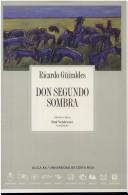
Don Segundo Sombra
Ricardo Güiraldes · 1886–1927 · Argentina
Originally Don Segundo Sombra (Spanish)
Why it matters
An orphaned boy apprentices himself to an aging, taciturn gaucho across the Argentine pampas. A lyrical elegy for a figure of national identity already being erased by modernization.
At a glance
Lyrical, gaucho-dialect-inflected prose slows an otherwise simple coming-of-age plot.
Deep dive
The mentor's name means 'shadow' — a hint Güiraldes plants early about exactly what kind of presence he's building, and exactly how much substance a myth is allowed to keep once history moves on.
Written for readers who have finished the book. No plot recap, and nothing here is safe to read first.
Themes & symbolism
Güiraldes builds the gaucho not as a realistic social type but as a receding myth even within the story's own timeframe — Don Segundo Sombra is deliberately underdrawn as an individual, taciturn to the point of opacity, so he can function as a distilled ideal of stoicism, competence, and self-sufficiency rather than a psychologically particular man. The novel's elegiac tone comes from writing a way of life in loving present-tense detail — cattle drives, horse-breaking, the gaucho's practical codes — while never letting the reader forget that Güiraldes and his 1920s readers already knew land enclosure and modernization had made this world extinct outside the book's own pages.
The narrator's coming-of-age and his mentor's characterization are the same project: Fabio absorbs Segundo Sombra's skills and reticence as a kind of inheritance that has nothing to do with blood, in contrast to the actual inheritance — land, a name, a landowner father — that the plot hands him late and that pulls him toward the settled, propertied order the itinerant gaucho life stands outside of. The pampas landscape itself, described in a gauchesca vocabulary Güiraldes mines from oral and literary tradition, is never separable from the way of life it hosts; losing access to one is losing the other.
Sombra as prophecy
A shadow has no fixed substance, follows without leading, and disappears the moment its source moves on — which is exactly the role Don Segundo Sombra plays in Fabio's life and exactly what happens to him at the end. Güiraldes plants the name early as incidental color, but it's been describing the character's entire narrative function from the start: present, formative, and ultimately insubstantial once the sun of the boy's new propertied life changes angle.
Inheriting out of the gauchesca tradition
The novel sits deliberately in the lineage of José Hernández's Martín Fierro, Argentina's foundational gaucho epic, but inverts its stance — where Fierro is a story of persecution and resistance, Güiraldes's gaucho is already a settled national icon by 1926, safely admirable precisely because he's no longer a threat to anyone, which is part of what the book quietly mourns even as it canonizes him.
That shift from outlaw to icon says as much about 1920s Argentina as about the gaucho himself: an urbanizing, immigrant-swelled nation was busy assembling a usable rural past just as the actual rural labor system the gaucho belonged to was being fenced, wired, and modernized out of existence, and Güiraldes's novel is one of the central documents of that assembly, mourning a way of life partly in order to help install it as national myth.
The last seal: what actually happens, and why it lands the way it does.
The ending, explained
Once Fabio's parentage is revealed and he inherits land and a name, the itinerant apprenticeship that structured the whole novel has nowhere left to go — Segundo Sombra, whose entire identity is bound to motion and ownerlessness, cannot follow his apprentice into a landowning life, so he simply rides off alone across the pampas, his silhouette shrinking into the plain in the novel's final image. There's no argument, rupture, or farewell scene; the parting is as wordless as the man himself, and Güiraldes lets the shadow literally lengthen and vanish as the closing figure for an entire way of life the narrator will now only carry forward as memory and code, not as a life he can actually keep living. The novel ends on Fabio alone with that image rather than with any scene of his new, settled life, insisting to the last that the apprenticeship mattered more than the inheritance that ends it.
Where to go next
 Rómulo Gallegos · 1929Doña BárbaraLvl 4Medium pace
 Horacio Quiroga · 1917Stories of Love, Madness, and DeathLvl 4Fast paced
 Mariano Azuela · 1915The UnderdogsLvl 4Fast paced
 José Lezama Lima · 1966ParadisoLvl 10Slow burn
 Silvina Ocampo · 1959Thus Were Their FacesLvl 5Fast paced
 Alejo Carpentier · 1949The Kingdom of This WorldLvl 5Medium pace