
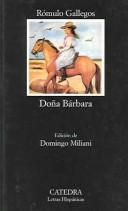
Doña Bárbara
Rómulo Gallegos · 1884–1969 · Venezuela
Originally Doña Bárbara (Spanish) · translated by Robert Malloy
Why it matters
A civilizing young rancher clashes with a savage, sorceress-like landowner over the Venezuelan plains. The novela de la tierra's defining struggle between order and wilderness, and a founding text of Latin American realism.
At a glance
A straightforward allegorical conflict told in vivid, descriptive realist prose.
Deep dive
What it means that the villain and the land she rules over share a name, and why her ending refuses to give the reader a body.
Written for readers who have finished the book. No plot recap, and nothing here is safe to read first.
Themes & symbolism
Doña Bárbara is never just a character in the civilización/barbarie scheme Gallegos inherits from nineteenth-century Latin American letters — she's the llano's own psychology given a name and a body. Raped as a girl by river pirates who also murder the one man she loved, she remakes herself into the plains' most feared cacica, using sorcery, seduction, and manipulated boundary markers (corrimiento de cercas) to swallow her neighbors' land the way the wilderness itself swallows anything not actively defended. Santos Luzardo, arriving with a law degree and a plan to fence, survey, and modernize his inherited ranch, isn't just her adversary; he's the novel's instrument for testing whether reason and law can actually discipline a landscape that has organized itself, for generations, around whoever is most ruthless.
The barbed wire Santos strings across the open range is the novel's central image of contested progress — a literal line drawn through terrain that has never recognized one, provoking as much violence as it prevents. Doña Bárbara's daughter Marisela, raised half-feral and illiterate until Santos takes an interest in her education, becomes the site where the novel stages its resolution: civilizing a person rather than conquering a place, redemption running through the next generation because the current one, epitomized by her mother, is judged too far gone to reclaim.
The Devourer and the Devoured
Locals call Doña Bárbara "devoradora de hombres," a man-eater, and the novel lets that reputation do double duty: it's misogynist folklore turning a trauma survivor into a monster, and it's also, uncomfortably, an accurate description of how she's chosen to survive. Gallegos doesn't fully resolve that tension — the novel wants her punished as a barbarous obstacle to progress and understood as a woman remade by violence into something the plains rewards, and it never quite decides which reading should win, which is part of why she's outlasted the book's more schematic politics as a character.
A Novel That Elected Its Author
Gallegos's civilizing vision wasn't just literary: he was elected President of Venezuela in 1948, the country's first democratically elected leader in decades, partly on the strength of the reformist reputation this novel built him — and was overthrown in a military coup after only nine months in office. The irony wasn't lost on anyone: the real llano, and the real Venezuelan military, gave the author's fictional triumph of order over barbarie a much less tidy sequel than the one he'd written.
Where to go next
 Ricardo Güiraldes · 1926Don Segundo SombraLvl 5Medium pace
 Horacio Quiroga · 1917Stories of Love, Madness, and DeathLvl 4Fast paced
 Mariano Azuela · 1915The UnderdogsLvl 4Fast paced
 Silvina Ocampo · 1959Thus Were Their FacesLvl 5Fast paced
 Jorge Amado · 1958Gabriela, Clove and CinnamonLvl 3Fast paced
 Alejo Carpentier · 1949The Kingdom of This WorldLvl 5Medium pace