
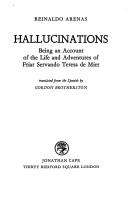
Hallucinations
Reinaldo Arenas · 1943–1990 · Cuba
Originally El mundo alucinante (Spanish)
Why it matters
A rebellious eighteenth-century friar flees across an increasingly delirious, shape-shifting Mexico and Europe. Freedom imagined in defiance of the real censorship and persecution closing in on its author.
At a glance
A delirious, shape-shifting picaresque blurs historical fact and fever-dream fantasy.
Deep dive
Why Arenas tells the real eighteenth century friar Fray Servando's escapes and imprisonments three separate times, in three different grammatical persons, and what that repetition argues about who gets to own a persecuted life.
Written for readers who have finished the book. No plot recap, and nothing here is safe to read first.
Themes & symbolism
The novel's engine, escape and recapture, mirrors the literal biography of Fray Servando Teresa de Mier, who in 1794 questioned the miraculous origin of the Virgin of Guadalupe and paid for it with a lifetime of exile, shipwreck, and prison across two continents. Arenas doesn't invent the persecution, he intensifies it into something closer to myth: each escape becomes more improbable than the last, from Spanish dungeons to Parisian rooftops, until the friar's actual eighteenth century itinerary starts to read like a fairy tale, not despite the historical record but because of how faithfully Arenas follows its more absurd turns.
The book's real formal argument sits in its narration: the same episode gets told in first person, then second, then third, cycling through grammatical positions until no single voice can claim final authority over what happened to Fray Servando. That refusal isn't a stylistic flourish, it's Arenas's answer to a life that official history, Church and Crown alike, kept trying to write in only one register: heretic, traitor, madman. Multiplying the pronouns multiplies the witnesses, and a man persecuted for saying the sanctioned story wasn't the only one gets a narrative built on exactly that principle.
Arenas also borrows the mechanics of the picaresque, a rogue on the road, a string of episodic disasters, a narrator too resourceful to stay caught, but strips out the genre's usual comic distance from cruelty. Where a classic picaro survives by wit alone, Fray Servando survives inquisitions, forged death certificates, and years of actual incarceration, and Arenas keeps insisting, through the sheer accumulation of punishments, that the joke and the atrocity are the same event described at different volumes.
A Cuban Writing an Eighteenth Century Mexican
Arenas wrote El mundo alucinante in Havana in 1965 and 1966, years before Cuban state censorship would make his own life resemble Servando's, and the manuscript had to be smuggled out of the country to reach print, first in French translation, because Cuban publishers wouldn't touch it. What reads on the surface as an eccentric historical romp about a colonial-era heretic became, in hindsight, a rehearsal for Arenas's own decades of surveillance, imprisonment, and eventual flight from Cuba: a fugitive intellectual whose thought outran what the state that produced him could tolerate, written by a writer about to become exactly that kind of fugitive himself. Arenas would later flee Cuba during the 1980 Mariel boatlift, an escape that makes the novel's obsessive rehearsal of flight read less like foresight than like a life imitating the book it hadn't happened to yet.
The last seal: what actually happens, and why it lands the way it does.
The ending, explained
Fray Servando's endless cycle of capture and escape finally breaks not because the Spanish crown relents but because Mexico does. Independence in 1821 gives him somewhere to return to as a hero rather than a hunted man, and he serves briefly in the new nation's congress before dying in Mexico City in 1827. Arenas doesn't let the ending resolve into triumph. The final pages keep the novel's rotating first, second, and third person technique running even here, so that the one death the book cannot multiply into another escape still arrives refracted through three different grammatical distances, as if even Fray Servando's actual, final death has to be witnessed from more than one position before Arenas will let it stand as fact.
Where to go next
 Reinaldo Arenas · 1992Before Night FallsLvl 4Medium pace
 Elena Poniatowska · 1971Massacre in MexicoLvl 5Medium pace
 Sergio Pitol · 1996The Art of FlightLvl 7Slow burn
 Jorge Ibargüengoitia · 1977The Dead GirlsLvl 4Fast paced
 Manuel Puig · 1976Kiss of the Spider WomanLvl 6Fast paced
 Gabriel García Márquez · 1967One Hundred Years of SolitudeLvl 6Medium pace