
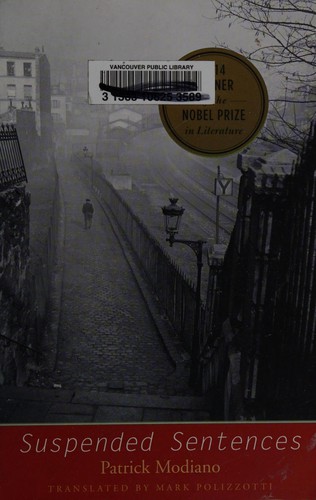
Suspended Sentences
Patrick Modiano · b. 1945 · France
Originally Suspended Sentences (French) · translated by Mark Polizzotti
Why it matters
Three linked novellas trace the narrator's fragmented childhood memories against the half-erased traces of wartime Paris. A concentrated dose of Modiano's essential method: history recovered only in glimpses.
At a glance
Short, plain sentences; difficulty lies in piecing together deliberately withheld connections.
Deep dive
Three linked novellas about children who grew up beside crimes and disappearances they couldn't see at the time, and the paper trails, photographs, court records, old addresses, an adult narrator uses to see them decades later.
Written for readers who have finished the book. No plot recap, and nothing here is safe to read first.
Themes & symbolism
All three novellas run the same investigation in different registers: an adult narrator, plainly built from Modiano's own postwar Paris childhood, reconstructs adults who vanished or turned out to be criminal, working from the flattest possible documentary traces, an undated photograph, a police blotter, an old street directory, rather than from memory's usual color. "Afterimage" and the title novella, "Suspended Sentences," the two that carry the book, both build entire investigations out of exactly this kind of paper record rather than recollection.
What recurs across all three is a child's blindness restored only in adulthood. In "Suspended Sentences," the narrator and his younger brother are minded by Annie and her circle of women in the Paris suburb of Jouy-en-Josas while unexplained men come and go at odd hours, and only the grown narrator, combing later through court records, learns Annie was on probation for her part in an actual criminal gang. "Afterimage" gives the photographer Francis Jansen's abrupt 1964 disappearance to Mexico the same delayed legibility, an archive of undated negatives, including images of a woman, Colette Laurent, already dead before the narrator ever met Jansen, that only cohere into a story decades on. "Flowers of Ruin," pairing an unsolved 1933 double suicide with the wartime occult underworld of the Left Bank, pushes the same method furthest from autobiography, proof that the book's real subject is the method itself rather than any single childhood.
Annie's Suspended Sentence, and the Title's Double Meaning
The title refers literally to Annie's probation, a criminal conviction deferred rather than served, but it doubles as a description of Modiano's own prose, sentences that trail off mid-thought, withhold verdicts, and name causes only partially. It also describes childhood itself as the book depicts it, a suspended understanding of adult crimes happening in plain sight, verdicts a child has no framework to render until decades of adult research finally supply one.
Jansen's Darkroom as Paris's Buried Archive
Jansen's abandoned negatives, undeveloped, unlabeled, half-legible, function across the collection as Modiano's recurring image for occupation-era Paris itself: a city whose true record was never written down cleanly, only left in fragments requiring a later, patient outsider to assemble. The narrator's slow cataloguing of Jansen's archive in "Afterimage" is less a job than a rehearsal for the method the whole trilogy runs, treating documentary residue as more reliable than any story anyone actually told him at the time.
Where to go next
 Patrick Modiano · 1978Missing PersonLvl 5Medium pace
 Javier Marías · 1992A Heart So WhiteLvl 8Slow burn
 J. M. G. Le Clézio · 1980DesertLvl 5Slow burn
 Michel Houellebecq · 1998The Elementary ParticlesLvl 5Medium pace
 W. G. Sebald · 1995The Rings of SaturnLvl 7Slow burn
 Alain Robbe-Grillet · 1957JealousyLvl 8Slow burn