
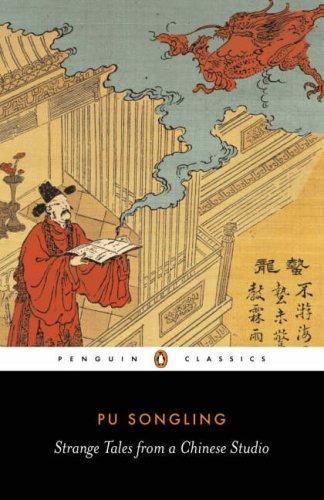
Strange Tales from a Chinese Studio
Pu Songling · 1640–1715 · China
Originally Liaozhai Zhiyi (Chinese) · translated by John Minford
Why it matters
Nearly five hundred tales of fox spirits, ghosts, and shape-shifters use the supernatural to needle corrupt officials and unjust marriages in Qing-dynasty China. Compact, polished classical prose housing some of Chinese literature's wildest incident.
At a glance
Individually short, self-contained tales in formal classical style, though the full collection is vast.
Deep dive
What five hundred ghost and fox-spirit tales, told mostly to failed and hopeful scholars, are doing with a sympathy nobody expects supernatural fiction to have.
Written for readers who have finished the book. No plot recap, and nothing here is safe to read first.
Themes & symbolism
Pu Songling failed the imperial examinations repeatedly across his own life, and that failure shapes the collection's recurring hero: a poor, honest scholar, overlooked by the examination system that is supposed to reward merit, who is instead rescued, tested, or loved by a fox spirit or ghost the human world would call a monster. The huli jing, or fox spirit, appears again and again as a figure of erotic and moral complexity, frequently more loyal, more intelligent, and more capable of real feeling than the human scholars or officials around her, which quietly inverts the collection's own culture's assumption that the supernatural is the dangerous, untrustworthy category.
Each tale closes with a short commentary voiced by 'the Historian of the Strange,' Pu Songling's own authorial persona borrowing the form of official dynastic histories, which append moral judgments to biographical entries. Using that same bureaucratic form to editorialize on a fox spirit's fidelity or a corrupt magistrate's cruelty is itself an argument: the strange deserves the same seriousness of judgment as the official record, and frequently behaves better than it does.
The Painted Skin's Warning About Beautiful Strangers
In one of the collection's most reprinted stories, a scholar takes in a beautiful young woman who turns out, glimpsed by accident through a window, to be a demon wearing a painted human skin like a garment, its true face a fanged horror underneath. Only a wandering Daoist priest recognizes the danger before it is too late, and the tale's horror comes less from the monster than from how ordinary and desirable her disguise is, a caution against reading beauty as evidence of safety that recurs across the collection in gentler and crueler forms alike.
Nie Xiaoqian and the Ghost Who Wants Out
Nie Xiaoqian is a young ghost enslaved by a tree demon and forced to lure traveling men to their deaths so the demon can feed on their blood. When she meets a scholar too virtuous to be tempted by her, she confesses the scheme instead of completing it, and he helps free her spirit and eventually gives her a proper burial and a place in his household. The story is characteristic of the collection's best-loved entries in refusing to treat 'monster' as a fixed identity: Xiaoqian is a captive dressed as a predator, and the tale's sympathy sides with her long before it sides with any of the men she was sent to kill.
Where to go next
 Lu Xun · 1921The Real Story of Ah-Q and Other TalesLvl 5Fast paced
 Wu Cheng'en · 1592Journey to the WestLvl 6Fast paced
 Shi Nai'an · 1370Water MarginLvl 7Fast paced
 Luo Guanzhong · 1400Romance of the Three KingdomsLvl 8Fast paced
 Cao Xueqin · 1791Dream of the Red ChamberLvl 9Slow burn
 Eileen Chang · 1943Love in a Fallen CityLvl 5Medium pace