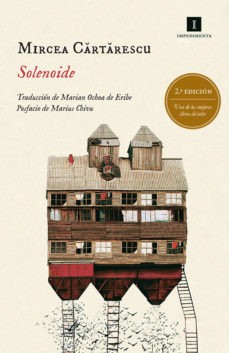
Solenoid
Mircea Cărtărescu · b. 1956 · Romania
Originally Solenoid (Romanian)
Why it matters
A failed poet turned schoolteacher discovers a mysterious device beneath his Bucharest house and descends into a vast metaphysical labyrinth. Cărtărescu's most ambitious novel, a thousand-page dream-logic epic.
At a glance
A thousand-page dream-logic labyrinth of digression, mathematics, and metaphysics.
Deep dive
A poem rejected decades earlier still rankles enough to send a failed-poet-turned-schoolteacher digging beneath his own Bucharest house, toward a device apparently built to answer a grudge against reality's basic architecture.
Written for readers who have finished the book. No plot recap, and nothing here is safe to read first.
Themes & symbolism
The unnamed narrator, a Romanian teacher at a decrepit Bucharest school, still nurses the wound of a youthful poem, 'The Fall,' read aloud at a writers' workshop decades earlier and dismissed by the group's most respected voice, an episode Cărtărescu draws almost unaltered from his own biography. That single, undramatic humiliation becomes the psychic origin the entire thousand-page novel keeps radiating outward from, a wound too small for anyone else to notice standing in for every larger defeat, artistic and metaphysical, that follows it.
The solenoid he eventually finds beneath his house, an electromagnetic coil apparently buried under several houses across the city in some larger, unexplained geometric arrangement, literalizes a lifelong protest against ordinary three-dimensional existence. Recurring imagery of mites, lice, and infestation treats the human body itself as evidence of hidden structures underneath visible reality, revulsion and revelation supplied by the same image, and the narrator's pursuit of the solenoids reads less as scientific investigation than as a mystic's rebellion against being sentenced to only three spatial dimensions and an ordinary, mortal span of time.
The Poem That Really Was Rejected
Cărtărescu did write and read a poem called 'The Fall' at a real Bucharest writing circle in his own youth, and did receive the kind of dismissal the novel dramatizes at length, a fact that turns Solenoid's opening wound from invented backstory into something closer to a documented grievance finally given a thousand pages to answer. Knowing this doesn't resolve whether the narrator's subsequent descent into metaphysical rebellion is delusion or genuine insight; it only confirms that the humiliation triggering it was real enough that its author apparently needed an entire novel to get even with it.
Bucharest's Buried Geometry
The solenoids the narrator maps beneath the city are never confirmed as anything beyond his own obsessive cartography, yet Cărtărescu gives the network enough internal consistency, other houses, other seekers, a shared and specific vocabulary for what the devices do, that choosing between delusion and conspiracy stops being a choice a reader can comfortably make. That standoff is the point: a private escape fantasy and a citywide, possibly cosmic structure are made to occupy the same buried coordinates, and Cărtărescu keeps both readings equally available all the way to the novel's own deliberately unresolved close.