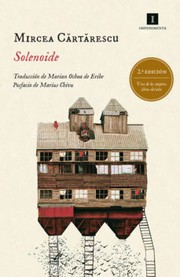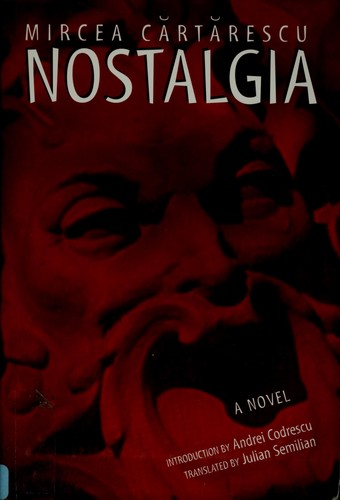
Nostalgia
Mircea Cărtărescu · b. 1956 · Romania
Originally Nostalgia (Romanian)
Why it matters
Linked stories of visionary, myth-drunk Bucharest boyhood build into something between memoir and cosmology. Cărtărescu's maximalist breakthrough, and a perennial case for the Nobel Prize.
At a glance
Hallucinatory, maximalist prose blending memoir, myth, and cosmology in dense imagery.
Deep dive
A gambler risking everything on a single spin opens the book, an old man's recursive nested dream closes it, and between them Cărtărescu turns a Bucharest apartment block childhood into cosmology.
Written for readers who have finished the book. No plot recap, and nothing here is safe to read first.
Themes & symbolism
The prologue, 'The Roulette Player,' introduces a gambler who escalates from small stakes to a single, final wager staged for a crowd inside a shabby apartment building, and functions less as a self-contained story than as a thesis for everything that follows: existence itself, Cărtărescu suggests, runs on the same vertiginous logic as a spinning chamber, and the three long pieces at the book's center all return to that same feeling of a child or an adolescent staking everything on one perception, one obsession, one dream.
'Mentardy' follows a strange, visionary child who wins over a courtyard of skeptical, sometimes cruel neighborhood kids by telling them increasingly elaborate stories, only to lose his hold over them once the enchantment runs out, a small parable about a storyteller's authority and how quickly an audience can withdraw it. 'The Twins' opens with a man's confession about dressing in women's clothes and folds backward into his adolescent, boundary-dissolving obsession with a classmate named Gina, doubling and gender instability treated as the same underlying condition. 'REM', the longest and final major piece, follows a boy through the same kind of crumbling Bucharest apartment blocks into a dream state that widens outward from one building's stairwell into something closer to a private cosmology.
Apartment Blocks as Bucharest's Underworld
Cărtărescu returns obsessively to the same setting across all three central pieces, Communist-era Bucharest tenements with their courtyards, stairwells, and shared attics, and treats that unglamorous socialist housing the way older myth treats a forest or an underworld: a bounded, ordinary-looking space that turns out to contain passages to somewhere much larger once a child's attention gets fixed on it closely enough.
The Architect's Nested Dream as a Closing Signature
The five-page epilogue, 'The Architect,' compresses the book's method into a single image: a man who dreams a world, only to discover that world is itself being dreamed by someone inside it, nested without an outer limit the text ever names. After three long, expansive pieces, Cărtărescu closes on the shortest, tersest one, letting the epilogue's brevity itself argue that the whole preceding structure could keep folding inward indefinitely, past wherever the book physically stops.