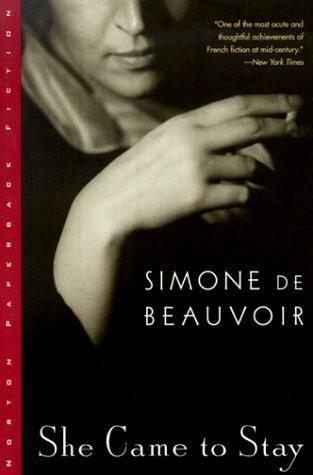
She Came to Stay
Simone de Beauvoir · 1908–1986 · France
Originally L'Invitée (French)
Why it matters
A couple's open relationship is tested when a younger woman moves in with them, jealousy curdling into something far darker. Beauvoir's debut novel, drawn directly from her own life with Sartre, and an early existentialist study of the Other.
At a glance
Sustained philosophical analysis of jealousy and consciousness within a long domestic plot.
Deep dive
A settled couple invites a magnetic younger woman into their carefully theorized open relationship, and Beauvoir tracks exactly how much philosophy it takes before jealousy stops caring about consistency.
Written for readers who have finished the book. No plot recap, and nothing here is safe to read first.
Themes & symbolism
Françoise and Pierre have built their relationship on a proud rejection of bourgeois possessiveness, a shared conviction that genuine love does not require exclusivity and that two sufficiently enlightened people can admit a third person into their intimacy without either partner's sense of self being threatened. Beauvoir spends the novel dismantling that theory from the inside by giving it a specific test case, Xavière, a magnetic, impulsive young woman the couple takes under their wing, and tracking with clinical patience how completely Françoise's intellectual commitment to non-possessive love fails to protect her from something closer to existential erasure as Pierre's attention shifts toward Xavière.
The novel's title, drawn from a line about hell being other people that Beauvoir's partner Jean-Paul Sartre would make famous in a different form the same year, frames Xavière's arrival less as a rival for Pierre's affection than as a direct challenge to Françoise's sense of being the fixed center of her own life. Françoise has organized her entire identity around a philosophy in which other consciousnesses are meant to be encountered generously, as equally sovereign subjects, but Xavière's presence keeps forcing Françoise to experience herself instead as an object under another person's judgment, something the theory never adequately prepared her to survive.
Beauvoir grounds the abstract battle of consciousnesses in unmistakably autobiographical material, the triangle closely mirrors her and Sartre's real involvement with Olga Kosakiewicz, and that lived specificity gives the novel's philosophical stakes real teeth: this isn't Sartrean theory illustrated by convenient characters, it's a woman who helped write that theory testing, through fiction, whether it actually holds up against the ordinary, unbearable experience of watching someone you love choose someone else in front of you.
Existentialism Tested Against Its Own Household
Published in 1943, the same year as Sartre's Being and Nothingness, She Came to Stay functions as an unofficial companion piece, dramatizing in narrative form the same problem of the Other's gaze that Sartre was formalizing in philosophy: the terror of being reduced to an object in someone else's consciousness rather than remaining the free subject of one's own. Beauvoir's fiction gets there first in some respects, and more viscerally, because Françoise's crisis is never merely conceptual. It's jealousy, sleeplessness, and eventually a decision, which makes the novel a genuine test of whether existentialist freedom can survive contact with an ordinary human heart rather than a purely theoretical proof of the idea.
The last seal: what actually happens, and why it lands the way it does.
The ending, explained
Françoise's theoretical generosity finally gives way entirely once she discovers that Xavière knows about a brief affair Françoise had with Pierre's friend Gerbert, an affair Xavière could expose and destroy Françoise's remaining relationships with, and Françoise, rather than confronting Xavière directly or accepting exposure, methodically turns on the gas in Xavière's room while she sleeps and leaves her to die, then returns to her own life reporting the death as an accident. Beauvoir stages the murder without theatrical build-up, almost procedurally, which is the point: after three hundred pages of philosophical language about mutual freedom and non-possessive love, the novel's actual climax is the oldest impulse in the book, the wish to simply eliminate a rival consciousness that has become unbearable to coexist with. Françoise's closing thought, that she has finally acted for herself alone, reads less as triumphant self-assertion than as confirmation that the theory could not, in the end, hold.