

Simone de Beauvoir
France
Analytical and self-scrutinizing, fiction used as a testing ground for ideas: measured sentences that examine feeling as rigorously as argument.
Beauvoir shed her strict Catholic upbringing by her teens and became, at twenty-one, the youngest person ever to pass France's grueling philosophy agrégation exam, narrowly outranked by Jean-Paul Sartre, whom she met that same year and bound herself to in a famous 'essential' partnership that allowed both of them other, 'contingent' loves. She taught philosophy in lycées until 1943, when a scandal over her relationship with a student cost her the post.
The Second Sex (1949), her sweeping study of women's constructed subordination, scandalized the French establishment and was placed on the Vatican's list of banned books; it became feminism's founding modern text. The Mandarins (1954), her novel of postwar Left Bank intellectuals, won the Prix Goncourt. She wrote frankly about her affair with the American novelist Nelson Algren, and died in Paris in 1986, buried beside Sartre in Montparnasse Cemetery.
Lines of influence
No descendants recorded, yet.
Their books in the atlas
- 1943
 She Came to StayLvl 6existentialist
 - 1954
 The MandarinsLvl 6political novel
Meanwhile, elsewhere
 1900–1989Sándor MáraiHungaryRussia & Eastern Europe · Hungary
 1905–1989Robert Penn WarrenUnited StatesNorth America · United States1908–2000William MaxwellUnited StatesNorth America · United States
 1902–1991Isaac Bashevis SingerPoland / United StatesNorth America · Poland / United States
 1899–1986Jorge Luis BorgesArgentinaLatin America · Argentina
 1903–1993Silvina OcampoArgentinaLatin America · Argentina
If you like Beauvoir, try
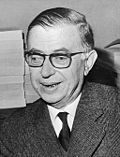 1905–1980Jean-Paul SartreFranceshaped Beauvoir · shared movement: Existentialism & the Absurd · kindred genres: existentialist
 1906–1989Samuel BeckettIreland / Franceshared movement: Existentialism & the Absurd · kindred genres: existentialist, psychological novel · both write in French
 1913–1960Albert CamusAlgeria / Franceshared movement: Existentialism & the Absurd · kindred genres: existentialist, psychological novel · both write in French
 1900–1999Nathalie SarrauteFrancekindred genres: psychological novel · both write in French · neighboring movements
 1929–1981Mariama BâSenegalshared movement: The Feminist Novel · kindred genres: psychological novel · both write in French
 1935–2023Kenzaburō ŌeJapanboth shaped by Sartre · kindred genres: psychological novel · neighboring movements