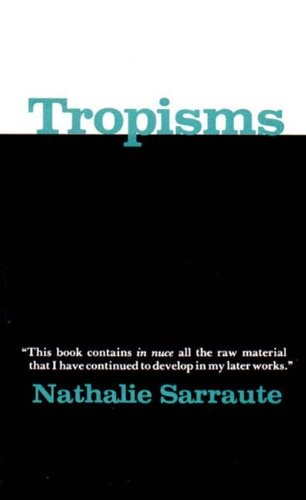
Tropisms
Nathalie Sarraute · 1900–1999 · France
Originally Tropismes (French)
Why it matters
Tiny, unnerving fragments capture the sub-verbal flickers of feeling beneath ordinary conversation, before they harden into cliché. Sarraute's debut announced the psychological method the nouveau roman would later formalize.
At a glance
Tiny, abstract fragments resist paraphrase by design.
Deep dive
Nathalie Sarraute's first book has no characters, no plot, and barely any punctuation to speak of, just two dozen small, exact captures of the flinches, resentments, and tiny surrenders that happen underneath a conversation about nothing at all.
Written for readers who have finished the book. No plot recap, and nothing here is safe to read first.
Themes & symbolism
Sarraute names her method after the involuntary responses of plants to light and gravity, and Tropisms, published in 1939, is built entirely out of these: twenty-four short, untitled prose pieces, most only a page or two, each isolating a single flicker of anxiety, resentment, or self-abasement moving beneath a scene of perfectly ordinary social contact, a family gathering, a woman waiting for a compliment, an old relative dominating a room by sheer inertia. There is no plot connecting the pieces and almost no named characters; Sarraute strips away exactly the apparatus, backstory, motive, resolution, that a conventional short story would use to make its people legible, on the argument that this apparatus was always a falsification of how consciousness actually moves.
The book's anonymous figures, referred to mostly as 'she' or 'they' rather than by name, let Sarraute generalize each tropism past any single character's particular situation; the elderly woman clinging to petty household routines in one piece and the anxious guest rehearsing a sentence before saying it aloud in another are less individuals than instances of a shared, recognizable human reflex, fear of being found wanting by the people closest to us. Published years before Sartre's Nausea and two decades before Robbe-Grillet's and Duras's fuller break with the traditional novel, Tropisms is now read as the founding document of the nouveau roman, a movement whose other practitioners, Sarraute included, kept crediting this brief, almost private book as the place their whole method actually started.
A Grammar Built to Slow the Reader Down
Sarraute's sentences in Tropisms resist easy consumption on purpose, piling clause on clause, repeating a phrase with slight variation, breaking off mid-thought, so that reading the book at the speed of ordinary prose is nearly impossible; the syntax itself performs the hesitation and self-correction her subjects are undergoing. That difficulty was, by her own account, the point rather than an obstacle: a tropism is by definition faster than conscious thought, and Sarraute wanted a prose style slow and exact enough to catch something that ordinarily happens beneath a reader's, and a character's, own notice.
Reissued, Expanded, Never Revised
Sarraute added new pieces to Tropisms for a 1957 reissue, after nouveau roman readers had made her a central figure of the movement, but she left the original 1939 texts untouched rather than smoothing them to match her later, more assured style; the book stands as a rare case of an author's debut being retroactively canonized by the movement it started, without the author revising the debut to fit the canon that grew up around it. The seam between the 1939 and 1957 material is faint but real, an earlier, more instinctive version of the method sitting directly beside pieces written once Sarraute already knew exactly what she was doing.