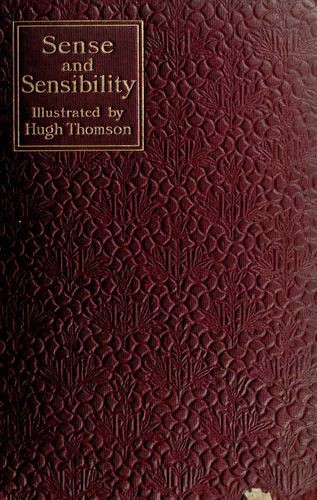
Sense and Sensibility
Jane Austen · 1775–1817 · England
Why it matters
Two sisters, one guarded by reason, one governed by feeling, navigate love and financial precarity after their father's death leaves them dependent on unreliable men. Austen's first published novel, and her plainest statement of the temperamental contrast she'd spend her career complicating.
At a glance
Clear early Austen prose, though less subtle than the free indirect style she'd later perfect.
Deep dive
Two sisters run their emotional lives on opposite operating systems after their father's death leaves them financially dependent on unreliable men, and Austen's first published novel is far less certain than its title suggests about which system actually wins.
Written for readers who have finished the book. No plot recap, and nothing here is safe to read first.
Themes & symbolism
Austen opens by watching Fanny Dashwood talk her husband John out of a deathbed promise to his half-sisters in real time, a masterclass in self-interested reasoning that talks a generous bequest down to nothing at all without either speaker ever admitting that's what's happening, and the scene sets the terms for everything that follows: Elinor and Marianne Dashwood are about to discover exactly how little the social world around them will do to protect two women with feeling but no fortune. Elinor's sense, her practiced discretion and self-command, isn't presented as simply correct against Marianne's excess; it's presented as a survival strategy adopted by someone who has learned, the hard way, that a woman in her position can't afford to let her feelings be legible to people with power over her.
Marianne's sensibility, her total, undisguised commitment to feeling everything as intensely as it arrives, gets her exactly what the novel's title structure implies it will: Willoughby's public courtship and sudden abandonment for a wealthier match nearly destroys her, a fever brought on by grief and weather that reads as her body finally registering what her judgment refused to. But Austen doesn't let Elinor's restraint go untested either. She spends most of the novel carrying, in total silence, the knowledge that the man she loves, Edward Ferrars, is secretly engaged to someone else, a burden every bit as consuming as Marianne's public collapse, just performed where no one but the reader can see it.
Lucy Steele, Playing the Long Game Austen Almost Admires
Lucy Steele's secret engagement to Edward, contracted years before the novel begins and kept alive through calculated patience rather than affection, makes her one of Austen's shrewdest minor characters: she reads the room at every turn, cultivates exactly the right allies, and abandons Edward the instant his disinheritance makes him worthless to her, transferring her ambitions smoothly to his newly wealthy younger brother instead. Austen never asks the reader to like her, but the novel's own social logic, that marriage is frequently the only asset a woman without money has to trade, makes Lucy's ruthlessness less a personal flaw than the sharpest possible demonstration of the same economic pressure squeezing every woman in the book, Elinor and Marianne included.
The last seal: what actually happens, and why it lands the way it does.
The ending, explained
Lucy's abrupt switch of allegiance from the disinherited Edward to his brother Robert frees Edward to marry Elinor after all, a resolution Austen delivers almost anticlimactically, as if to underline that Elinor's long, silent suffering deserves a quiet reward rather than a dramatic one. Marianne, chastened by her illness and by watching Willoughby's own confession of regret change nothing about the choice he actually made, settles into a marriage with Colonel Brandon, the steady, older suitor she'd earlier dismissed as too dull for real feeling, and Austen frames the match not as a diminishment of her passionate nature but as its maturation into something less likely to nearly kill her again. Both sisters end married and financially secure, but the novel's closing balance sheet, quite literally, of who ends up with what income, keeps the reader aware that survival here was never purely a matter of temperament.