
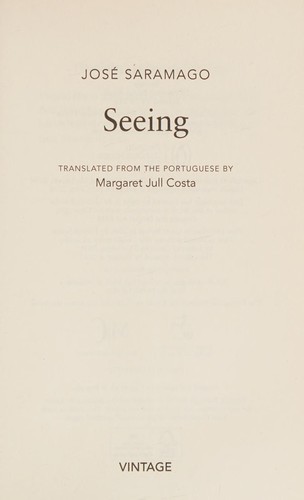
Seeing
José Saramago · 1922–2010 · Portugal
Originally Ensaio sobre a Lucidez (Portuguese) · translated by Margaret Jull Costa
Why it matters
Four years after Blindness, the same unnamed city holds an election and eighty-three percent of ballots come back blank. Saramago's loose sequel turns a government's panic at peaceful, silent dissent into a chilling parable about power's fear of an untraceable will.
At a glance
Same demands as Blindness: unbroken paragraphs, unnamed characters, no quotation marks.
Deep dive
What a government does when the vast majority of a capital city casts a blank ballot instead of a protest vote or an abstention, and discovers there is no ringleader anywhere to arrest.
Written for readers who have finished the book. No plot recap, and nothing here is safe to read first.
Themes & symbolism
On election day in an unnamed capital, heavy rain keeps turnout thin until the last hour, when voters suddenly flood the polls, and the count reveals over eighty percent of ballots left blank, not spoiled, not abstained, deliberately blank. A rerun a week later produces an even higher blank vote, and Saramago spends the novel's early chapters inside the government's mounting panic at a form of refusal that cannot be blamed on any party, leader, or manifesto, because a blank ballot, unlike a vote for the opposition, offers nothing for power to argue with. Saramago never names the country, but the mechanics, a cabinet debating whether to let the capital's own uncollected rubbish pile up as a punishment, read as a composite of any democracy convinced its own capital can be starved back into obedience.
The government's response escalates from denial to full siege: ministers withdraw the police, cordon off the capital, and eventually stage a bombing at a subway station to manufacture the appearance of a terrorist conspiracy behind the vote, evidence the novel lets the reader see constructed in real time. Saramago's target is not the blank vote itself but the reflex of power to treat any collective act it cannot narrate as evidence of an enemy it needs to invent, a state more frightened of an unreadable public than of an openly hostile one, willing to manufacture a corpse before it will accept a silence it cannot explain.
The Woman Who Never Went Blind, Framed Again
Seeing is a direct sequel to Blindness, set four years after that novel's epidemic of white blindness swept the same unnamed city, and its investigation eventually settles on the one woman who never lost her sight during that earlier crisis as the suspected mastermind behind the blank vote, despite there being no evidence she organized anything. Saramago uses her return to connect the two catastrophes explicitly: a city that once literally could not see is now treated as dangerous for seeing too clearly, and the authorities' need for a visible leader behind an act of collective, leaderless clarity drives the plot to its most paranoid extreme. Saramago published the sequel in 2004, at eighty-one, still testing how far an ordinary parliamentary democracy could curdle without a single law being formally broken.
The last seal: what actually happens, and why it lands the way it does.
The ending, explained
A police superintendent sent to investigate the doctor's wife grows steadily more uneasy with his own assignment, refusing at key moments to fabricate the evidence his superiors want, but his conscience cannot outpace the operation already in motion. Government agents kill the doctor's wife, framing her final act of resistance as confirmation of the very conspiracy that never existed. The novel closes without any public reckoning, the true report of what happened destined to be buried under the official account, Saramago's bleakest statement yet that a state willing to invent an enemy will not be talked out of the invention by facts.
Where to go next
 José Saramago · 1982Baltasar and BlimundaLvl 7Medium pace
 José Saramago · 1991The Gospel According to Jesus ChristLvl 7Slow burn
 José Saramago · 1995BlindnessLvl 7Medium pace
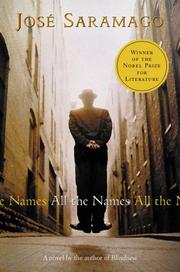 José Saramago · 1997All the NamesLvl 6Slow burn
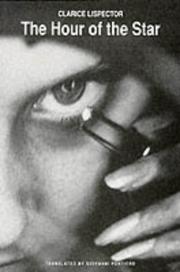 Clarice Lispector · 1977The Hour of the StarLvl 7Slow burn
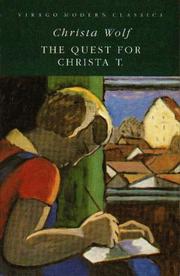 Christa Wolf · 1968The Quest for Christa T.Lvl 7Slow burn