
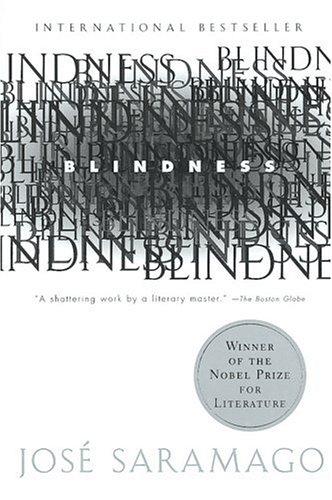
Blindness
José Saramago · 1922–2010 · Portugal
Originally Ensaio sobre a cegueira (Portuguese) · translated by Giovanni Pontiero
Why it matters
An unexplained epidemic of white blindness sweeps a city, and the social contract rots within days. Saramago's pitiless parable (told in flooding, punctuation-defying sentences) of how thin the veneer of civilization is.
At a glance
Unbroken paragraphs with no quotation marks or named characters strain sustained reading.
Deep dive
A city goes blind in waves, an epidemic with no cause and no cure, except for the one woman who never stops seeing what everyone else is doing to each other.
Written for readers who have finished the book. No plot recap, and nothing here is safe to read first.
Themes & symbolism
Saramago withholds every character's name throughout — the doctor, the doctor's wife, the girl with dark glasses, the man with the black eye patch — reducing the cast to functions rather than individuals the instant the epidemic strips away the ordinary infrastructure (jobs, addresses, reputations) that used to distinguish them. The effect isn't dehumanizing so much as diagnostic: without names, the novel argues, a person's social identity turns out to be far more fragile and external than anyone assumed, and what people actually do once it's gone — for good or for atrocity — is the only thing left to define them.
The doctor's wife's exemption from the 'white blindness' is less a gift than an unbearable burden: she alone can see the quarantine ward's descent into filth, hierarchy, and eventually organized rape by the ward's self-appointed criminal faction, and Saramago uses her isolated sight to indict the armed guards outside, who represent an entire society's willingness to let the blind police themselves in squalor rather than address the crisis directly. Her eventual act of killing the gang's leader is presented without triumph — necessary violence rather than heroism, the cost of being the one person still capable of seeing what needs to be done.
The novel's punctuation — no quotation marks, minimal paragraph breaks, dialogue running directly into narration with only capital letters to mark a new speaker — formally enacts the blindness itself: readers have to work, sentence by sentence, to keep track of who's speaking in a text that refuses the ordinary visual scaffolding of a novel, so the difficulty of reading it mirrors the characters' own loss of the visual cues that used to organize their world.
A Style Built to Disorient
Saramago's refusal of standard punctuation isn't a gimmick sustained for one scene but the governing method of the entire novel, and it has the effect of making even calm passages faintly disorienting to read — exactly appropriate to a book about people losing their most basic tool for organizing reality. The style has drawn comparisons to late Beckett for its austerity, but where Beckett strips language down toward silence, Saramago keeps the sentences running, almost breathlessly, which reads less like minimalism than like a mind refusing to stop narrating even as its own coordinates disappear.
The last seal: what actually happens, and why it lands the way it does.
The ending, explained
Sight returns to the city as suddenly, universally, and unexplainably as it vanished, with no medical or narrative cause ever supplied — the epidemic simply lifts, first for the doctor's wife's small group and then, it's implied, everywhere. Saramago refuses the reader any account of what caused or cured it, because the novel was never really about a medical mystery; the 'blindness' the title diagnoses was always more about how readily people abandon decency once the usual social safeguards fail than about literal sight. The closing lines belong to the doctor's wife, who wonders aloud whether they ever actually went blind at all, or whether they were blind all along and simply seeing — a final reversal that refuses the comfort of treating the epidemic as an aberration rather than a revelation.
Where to go next
 José Saramago · 1982Baltasar and BlimundaLvl 7Medium pace
 José Saramago · 1991The Gospel According to Jesus ChristLvl 7Slow burn
 José Saramago · 1997All the NamesLvl 6Slow burn
 José Saramago · 2004SeeingLvl 7Slow burn
 Clarice Lispector · 1977The Hour of the StarLvl 7Slow burn
 Christa Wolf · 1968The Quest for Christa T.Lvl 7Slow burn