
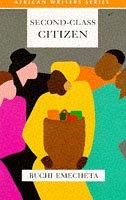
Second-Class Citizen
Buchi Emecheta · 1944–2017 · Nigeria
Why it matters
Adah leaves Lagos for a cramped, racist London, fighting to write and raise five children while her husband unravels. Emecheta's autobiographical debut is the immigrant half of the story The Joys of Motherhood tells from home.
At a glance
Plain, direct prose; the difficulty is emotional rather than structural.
Deep dive
Adah fights her own family just to be allowed into a classroom as a girl, and gets to London only to discover the marriage that was supposed to reward all that ambition has its own ideas about how far a wife is allowed to go.
Written for readers who have finished the book. No plot recap, and nothing here is safe to read first.
Themes & symbolism
Adah grows up in Lagos in a family that spends money readily on her brother's schooling and grudgingly, if at all, on hers, and forces her own education into existence from early childhood, walking herself to a school she was never enrolled in and refusing to leave until someone lets her stay. Emecheta establishes early and without sentimentality that Adah's drive toward literacy and independence is not a personality quirk but a survival strategy in a world that has already told her, repeatedly and by every available authority, that a girl's ambition is at best tolerated and at worst actively punished.
Marrying Francis is, for Adah, less a romance than a practical mechanism for reaching England, where she imagines an education and a career finally becoming possible on their own merits rather than despite her gender; Emecheta is blunt about the transactional logic underneath the marriage from the very start. London delivers neither the meritocracy nor the escape Adah expected: she and Francis face landlords who post 'no coloureds' openly, and Francis, threatened rather than supported by a wife who works, studies, and eventually earns more than he does, grows steadily more controlling and violent, treating Adah's competence as an insult he is entitled to correct.
Emecheta draws the novel closely from her own early years in London, and that autobiographical pressure shows in how precisely the book tracks the domestic economics of the marriage, the childcare, the rent, the unpaid labor Adah performs on top of a full-time job, without ever letting those details soften into background texture; they are the mechanism by which Francis keeps Adah dependent even as she becomes objectively more capable than him. Adah's growing ambition to write becomes the novel's clearest battleground, since a wife with her own voice on paper is, for Francis, a threat with no obvious counter beyond simply destroying the pages.
Second-Class on Two Continents at Once
The title's 'second-class citizen' describes Adah's status in England, denied housing and treated as suspect by a country she had trusted to reward hard work, but Emecheta means the phrase to double back onto Lagos as well, the household that raised a bright daughter and funded her brother's education instead. Adah crosses an ocean looking for a system that will finally judge her by ability rather than by sex, and Emecheta's bleakest joke is how completely both systems, colonial Britain and her own natal family, agree on where to rank her.
The last seal: what actually happens, and why it lands the way it does.
The ending, explained
After years of Francis controlling her earnings, resenting her studies, and treating her ambitions as personal insults, the marriage's breaking point arrives when Francis burns the manuscript of Adah's first novel rather than read it, an act of destruction Emecheta stages as the plainest possible statement of what he actually thinks her voice is worth. Adah leaves him, taking their children and filing for the independence she had assumed marriage itself would eventually deliver, and the novel closes with her poorer, more exhausted, and considerably freer than she has been at any earlier point in the book. Emecheta refuses a triumphant ending in favor of something closer to a beginning: Adah alone with her children and an unwritten future, having finally understood that no marriage, and no country, was ever going to hand her the equality she wanted to earn herself.
Where to go next
 Buchi Emecheta · 1976The Bride PriceLvl 4Medium pace
 Buchi Emecheta · 1979The Joys of MotherhoodLvl 4Medium pace
 Chinua Achebe · 1958Things Fall ApartLvl 4Medium pace
 Tsitsi Dangarembga · 1988Nervous ConditionsLvl 4Medium pace
 Ngũgĩ wa Thiong'o · 1967A Grain of WheatLvl 6Slow burn
 Chimamanda Ngozi Adichie · 2006Half of a Yellow SunLvl 4Fast paced