
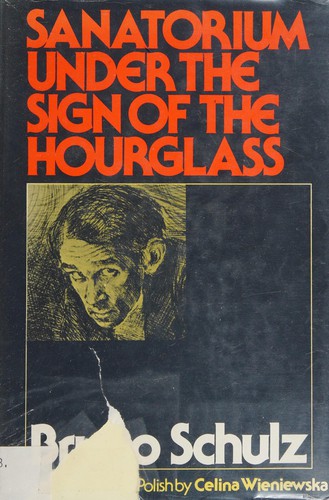
Sanatorium Under the Sign of the Hourglass
Bruno Schulz · 1892–1942 · Poland (Galicia)
Originally Sanatorium Pod Klepsydrą (Polish)
Why it matters
A son visits a sanatorium where his dead father still lives, time run backward. Schulz's second and last collection deepens his hallucinatory, myth-drenched vision before the Holocaust cut his work short.
At a glance
Hallucinatory, metaphor-dense prose and dissolving time and logic resist a literal reading.
Deep dive
A son visits a sanatorium where a clever trick with time keeps his dead father technically alive, and how Schulz turns that loophole into a survey of his whole mythic Drohobycz.
Written for readers who have finished the book. No plot recap, and nothing here is safe to read first.
Themes & symbolism
In the title story, the narrator Joseph travels to a sanatorium where Dr. Gotard explains the institution's actual method: by setting the local clock back, they delay a patient's death rather than reverse it, so Joseph's father is simultaneously dead in the outside world and alive, running his old shop, inside the sanatorium's borrowed time. Schulz treats this less as science fiction than as an argument about grief, that the dead stay legible to us only inside private, degraded, or looped versions of the time we shared with them.
'The Book' opens the collection with young Joseph's memory of a torn, half-destroyed volume he's convinced was once the one true Book underlying all others, an authenticated bible of wonder later editions and forgeries can only imitate, and 'Spring' expands that same hunger for a lost total text into a hallucinatory, empire-scaled fantasy triggered by a stamp album. Schulz calls his method, in an essay written around the same period, 'the mythologization of reality': ordinary objects, a shop, a stamp, a sanatorium timetable, keep splitting open into cosmology under a child's or a mourner's attention.
Dr. Gotard's Loophole
The sanatorium's premise, that death can be locally delayed by resetting the clock rather than cured, gives Schulz a mechanism for keeping the father figure who dominates his fiction available for one more transformation, and one more scene, without contradicting what the reader already knows happened to him. It is grief logic dressed as institutional procedure, and Schulz never breaks the deadpan bureaucratic tone Dr. Gotard uses to explain it.
Dodo and Eddie at the Family's Edge
The portraits of Joseph's cousins Dodo and Eddie, one intellectually disabled, one incapacitated after a fall, sit outside the book's mythic set pieces but do real work: Schulz describes both men with the same close, unsentimental attention he gives inanimate objects elsewhere, border figures the family accommodates without fully integrating, a quieter version of the human-to-thing slippage that runs through everything else he wrote. Both sketches appear late in the collection, after the more elaborate mythic pieces, and their plainer, harder attention reads as a deliberate comedown from the fantastical register the book has spent most of its length building.
Where to go next
 Bruno Schulz · 1934The Street of CrocodilesLvl 8Slow burn
 Franz Kafka · 1915The MetamorphosisLvl 4Medium pace
 Witold Gombrowicz · 1937FerdydurkeLvl 7Fast paced
 Bohumil Hrabal · 1976Too Loud a SolitudeLvl 6Slow burn
 Milan Kundera · 1984The Unbearable Lightness of BeingLvl 5Slow burn
 Haruki Murakami · 1987Norwegian WoodLvl 3Fast paced