
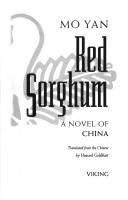
Red Sorghum
Mo Yan · b. 1955 · China
Originally Hong Gaoliang Jiazu (Chinese) · translated by Howard Goldblatt
Why it matters
Bandits, distillers, and the anti-Japanese resistance in rural Shandong, narrated by a grandson mythologizing his outlaw grandparents. García Márquez and Faulkner transplanted into Chinese soil: the post-Mao literary explosion's banner novel.
At a glance
Nonlinear multigenerational narration mixing myth, brutality, and shifting time.
Deep dive
Why a novel built almost entirely from atrocity reads, against all odds, as a fertility myth — and why its narrator keeps confessing that he is the weak link in his own bloodline.
Written for readers who have finished the book. No plot recap, and nothing here is safe to read first.
Themes & symbolism
Mo Yan fuses blood and wine from the first pages and never lets the two separate again: the family distillery's sorghum liquor is described in the same sensory register as the massacres that soak the fields around it, so that the crop itself becomes the novel's real protagonist — indifferent, cyclical, feeding on whatever is poured into the soil, whether that's rain, semen, or the blood of Japanese reprisals. The sorghum isn't a backdrop to the violence, it's the thing the violence and the desire are both in service of; harvest, distillation, and slaughter are treated as versions of the same elemental process, which is what gives the book's most horrific scenes (the flaying, the massacres) their strange, hallucinatory calm rather than pure horror.
The other engine of the book is the frame narrator's insistence, stated almost as a thesis in the opening pages, that his grandparents' generation was larger, wilder, and more alive than his own — that something has been lost between the bandit-lovers who killed a leprous husband and seized a resistance and the diminished grandson reconstructing their story secondhand. This isn't nostalgia in the soft sense; it's presented as something closer to biological and moral fact, an argument about decline that the novel never fully lets its narrator (or its reader) escape. Dai Fenglian and Yu Zhan'ao are granted a moral freedom — to kill, to desire, to lead — that the book implies history has since foreclosed, which is exactly what licenses its Faulknerian, myth-drunk telling: this is what a family tells itself once it can no longer act as its ancestors did.
Myth-making as method, not decoration
The novel's fractured, looping chronology isn't a stylistic flourish laid over a straightforward war story — it's the argument. A grandson can't narrate his grandparents' lives as reportage; he can only narrate them as legend, which is why the book keeps circling back to the same scenes from different angles, inflating them, contradicting its own earlier claims, treating memory as something actively built rather than recovered. Read this way, the Márquez and Faulkner comparisons that greeted its translation abroad are more than a marketing shorthand: like One Hundred Years of Solitude, Red Sorghum uses a family's accumulated legend to stand in for a nation's buried history, and like Faulkner's Yoknapatawpha novels, it treats a single stretch of land as inexhaustible, generation after generation staining the same fields with the same blood. The book arrived at a specific moment — the post-Mao literary thaw, when Chinese writers were suddenly permitted to depict rural violence, sexuality, and moral ambiguity that decades of socialist-realist convention had scrubbed out — and its wildness of form was itself a political act, a refusal of tidy, approved narrative in favor of something closer to how a family actually remembers.
The last seal: what actually happens, and why it lands the way it does.
The ending, explained
The novel doesn't resolve into a single climactic scene so much as let its accumulated atrocities and betrayals settle back into the land that has absorbed all of it. The narrative's last returns are to the sorghum fields themselves — vast, red, blood-fed, and still growing — rather than to any character's fate being tidily closed off. That refusal is the point: the grandson-narrator's framing has argued all along that the field outlives and outsizes the people who die in and for it, so the ending simply lets the crop stand as the novel's true, undiminished inheritor. His generation gets the story; only the land gets the vitality.
Where to go next
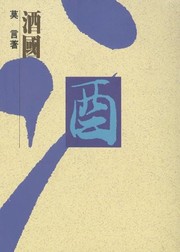 Mo Yan · 1992The Republic of WineLvl 8Medium pace
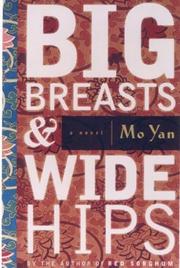 Mo Yan · 1996Big Breasts and Wide HipsLvl 8Fast paced
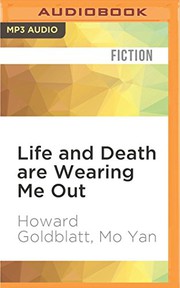 Mo Yan · 2006Life and Death Are Wearing Me OutLvl 7Fast paced
 Mo Yan · 2009FrogLvl 6Medium pace
 Gabriel García Márquez · 1967One Hundred Years of SolitudeLvl 6Medium pace
 Lu Xun · 1921The Real Story of Ah-Q and Other TalesLvl 5Fast paced