
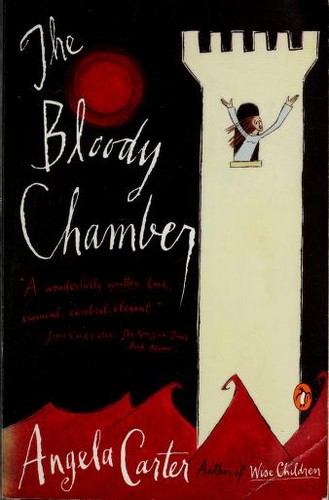
The Bloody Chamber
Angela Carter · 1940–1992 · England
Why it matters
Bluebeard, Beauty and the Beast, and Red Riding Hood rewritten as tales of female appetite, danger, and power. Carter's gorgeous, gothic prose turned the fairy tale into a feminist laboratory.
At a glance
Ornate, allusive maximalist prose thick with fairy-tale and mythic reference.
Deep dive
What happens when Angela Carter hands Bluebeard's wife, Red Riding Hood, and Beauty a say in how their own stories go.
Written for readers who have finished the book. No plot recap, and nothing here is safe to read first.
Themes & symbolism
Carter called the collection an attempt to extract the 'latent content' from traditional fairy tales rather than simply retelling them, and the method shows in how closely each story tracks its source, Bluebeard, Red Riding Hood, Beauty and the Beast, Puss-in-Boots, while relocating the point of view and the terms of the ending entirely. The title story keeps Bluebeard's basic plot, a young bride, a forbidden room, a chamber full of dead predecessors, but narrates it in the bride's own voice, alert from the start to her own complicity in the marriage's erotic bargain, curious about the room specifically because curiosity has been marketed to her as the fatal feminine flaw she is now expected to perform.
Female desire runs through the collection as something the source tales treated as dangerous and Carter treats as simply true: the bride's fascination with her husband's violence, the heroine's arousal at the Beast's animal smell in 'The Courtship of Mr Lyon,' the young woman in 'The Tiger's Bride' who chooses to shed her own skin rather than be unwrapped by anyone else. Carter's prose, dense with Gothic ornament, mirrors, blood, fur, ice, works less as decoration than as the sensory register in which that desire gets to exist honestly for once, instead of being coded as either innocence or sin.
The Mother Who Rides In Armed
Carter's most decisive rewrite of Bluebeard is the rescue. Folk tradition sends the bride's brothers to save her at the last possible moment; Carter sends her mother instead, an old woman who once shot a man-eating tiger and a rabid dog with the same revolver, riding in on horseback with that revolver still in her hand. The image, mother over brothers, competence over chivalry, restates the whole collection's argument in a single tableau: rescue, when this book allows it at all, comes from women who have already survived their own dangerous men, not from men arriving to prove theirs.
Three Wolves, Three Different Girls
Carter closes the book with three consecutive versions of Red Riding Hood, 'The Werewolf,' 'The Company of Wolves,' and 'Wolf-Alice,' each one pushing further from the cautionary original. The first keeps the folk tale's brutal logic largely intact; the second lets the girl recognize the wolf as a man and choose him anyway, laughing, sleeping between his paws by the story's close; the third abandons a human heroine altogether for a feral child raised by wolves who slowly, tenderly, teaches herself to become human on her own schedule. Read in sequence, the three stories function as a controlled experiment: same warning, same forest, progressively less fear each time the girl is allowed actual agency.
Where to go next
 Angela Carter · 1984Nights at the CircusLvl 7Fast paced
 Anne Enright · 2007The GatheringLvl 5Medium pace
 André Gide · 1902The ImmoralistLvl 5Medium pace
 Elfriede Jelinek · 1983The Piano TeacherLvl 7Slow burn
 Christa Wolf · 1968The Quest for Christa T.Lvl 7Slow burn
 Annie Ernaux · 2008The YearsLvl 6Slow burn