
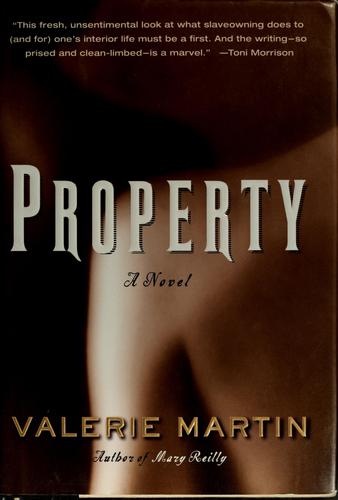
Property
Valerie Martin · b. 1948 · United States
Why it matters
A Louisiana plantation wife narrates her brutal marriage and her own possessive claim on Sarah, the enslaved woman given to her as a wedding gift. A short, claustrophobic first-person account that makes its narrator's moral blindness the entire indictment.
At a glance
A compact length hides real moral density in its narrator's self-serving, unreliable account.
Deep dive
A Louisiana plantation wife's private catalogue of grievances against the household's actual victim, and what Valerie Martin is doing by making her the only voice this novel allows to speak.
Written for readers who have finished the book. No plot recap, and nothing here is safe to read first.
Themes & symbolism
Manon Gaudet narrates all of Property from inside her own resentment: married against her preference to a sugar planter she despises, she directs her jealousy not at her husband's cruelty but at his open sexual claim on Sarah, the enslaved woman given to Manon as a wedding present, who bears her husband's son. Martin's structural choice, first person, entirely from the slaveholder's point of view, is the novel's argument made formal. Manon experiences her own life as one long injury, a bad marriage, a body Sarah's presence keeps reminding her she doesn't fully control, while remaining constitutionally unable to register Sarah, whom she legally owns and who has been violated and dispossessed by the same man, as anyone with a comparable claim on suffering.
Property, in Martin's telling, works as both a legal category and a psychological one: everything Manon owns is entangled with her husband's estate, Sarah included, so Manon's fury at her husband gets displaced sideways onto the one person even less free than she is. The plantation's daily brutalities, the whip, the sale of children, sit in Manon's narration as background noise she barely comments on, which is itself the horror the reader is being asked to notice. Martin sets the domestic plot against the historical pressure of an actual slave uprising spreading through the parish, a reminder that the system Manon takes for granted was never as settled, from the people living inside it, as she assumes.
A Narrator Who Never Learns
Martin gives Sarah no direct voice at all, a choice some readers have found as troubling as it is deliberate: the entire novel traps its reader inside a slaveholder's self-pity, with no scene, no aside, no narrative escape hatch into Sarah's own interiority. The discomfort is the design. A conventional redemption arc would eventually let Manon see what she has done; Property withholds that insight from her permanently, which is the harsher and more honest choice.
Freedom as Theft, in Manon's Accounting
When the uprising finally reaches the Gaudet plantation, wounding Manon and killing her husband, Sarah escapes in the confusion, leaving her older child behind. Manon's response is not reflection but pursuit: she hires men to track Sarah down and drag her back into bondage, experiencing the loss of her property as a wound fully equal to, if not greater than, anything Sarah herself has suffered. The scene stages, without commentary, exactly how completely the logic of ownership has replaced Manon's capacity for empathy.
The last seal: what actually happens, and why it lands the way it does.
The ending, explained
With Sarah returned to her by force, Manon refuses even the one offer of decency the novel extends: Mr. Roget, a free Black artisan in New Orleans, steps forward to purchase Sarah and her son, Walter, outright, and Manon turns him down, unwilling to relinquish what she still calls her property even when keeping it serves no purpose beyond spite. Martin denies the novel any conventional comeuppance, Manon is diminished, materially and socially, by the collapse of the plantation economy around her, but never brought to recognition. The book ends exactly where it began, inside Manon's narrow, self-justifying voice, still certain she is the wronged party, which is Martin's final and bleakest argument about what slavery does to the people who benefit from it.
Where to go next
 Colum McCann · 2009Let the Great World SpinLvl 5Medium pace
 Bernhard Schlink · 1995The ReaderLvl 3Medium pace
 Intizar Husain · 1979BastiLvl 6Slow burn
 Mercè Rodoreda · 1962In Diamond SquareLvl 5Medium pace
 Anne Michaels · 1996Fugitive PiecesLvl 7Slow burn
 Michael Cunningham · 1998The HoursLvl 5Medium pace