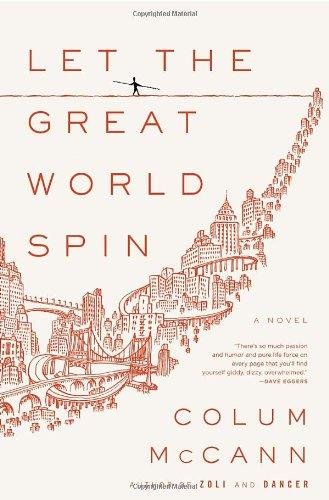
Let the Great World Spin
Colum McCann · b. 1965 · Ireland
Why it matters
A dozen disparate New Yorkers (a grieving mother, an Irish monk, a young judge) brush against Philippe Petit's real 1974 tightrope walk between the World Trade Center's towers. McCann's National Book Award winner became an unofficial elegy for a city the towers' loss later marked forever.
At a glance
A dozen interwoven narrators shift voice and register, though each individual thread reads clearly.
Deep dive
How a stranger walking a wire between two towers, never once named, becomes the fixed point a scattered, grieving city organizes itself around.
Written for readers who have finished the book. No plot recap, and nothing here is safe to read first.
Themes & symbolism
McCann never names the tightrope walker, though every reader recognizes Philippe Petit's real 1974 walk between the World Trade Center towers. That anonymity is deliberate: left as pure spectacle, the walk becomes a blank surface onto which each character projects whatever they need it to mean — miracle, stunt, metaphor for grace under a controlled kind of recklessness. The novel's structural bet is that a single wordless image, witnessed from a dozen unconnected sidewalks, can bind together lives a plot never would: a Park Avenue judge, a Bronx grandmother, an Irish monk living among prostitutes, a young hacker couple.
Corrigan, that monk, embodies a faith defined by proximity to degradation rather than distance from it — he lives among and loves the women he can't save, refusing the safety of a cleaner ministry. His death in a car crash, caused in part by the very woman he was protecting, is the novel's engine: it's the grief radiating outward from that one collision, not the walk itself, that eventually produces the book's most genuine connection.
That connection is Claire and Gloria — a wealthy Park Avenue mother and a Bronx mother, one who lost a son in Vietnam, the other three — meeting through a support group and forming a friendship the rest of the novel's rigidly segregated geography of class and race never otherwise permits. Where the tightrope walk offers connection as spectacle, Claire and Gloria's bond is connection as labor, made out of shared, unglamorous loss. McCann's title, lifted from Yeats's image of the world spinning on its lonely axis, frames grief less as an aberration than as the ordinary condition the walk briefly, beautifully interrupts.
Though it never appears on the page, September 11th haunts the novel by pure retrospective absence. Published in 2009 and built around a real 1974 walk that predates the towers' destruction by nearly three decades, the book can't help but let every intact image of them read as unbearably temporary to a reader who already knows what's coming. McCann never has to write the towers falling; he just has to keep describing them standing, tall and improbable, and let the reader supply the grief in advance.
Polyphony as Form
The novel refuses a single protagonist, braiding close first- and third-person chapters across race, class, and gender instead. That structure isn't just technique; it's the book's thesis rendered as form — a city, or a novel about one, only exists as the sum of testimonies that never quite meet, which is why the wire above them, holding one man in view of everyone at once, feels like such a relief.
Grief Without a Class System
A judge, a grieving Park Avenue mother, a Bronx grandmother, prostitutes, an addict monk: the walk is the one event in the novel every character can watch from wherever they happen to be standing, rich or poor, uptown or under the bridge, and that shared vantage is McCann's real formal argument. New York's geography otherwise sorts these lives strictly by block and income; grief and astonishment, for one August morning, refuse to sort themselves the same way.
The last seal: what actually happens, and why it lands the way it does.
The ending, explained
The threads converge less through plot than through accumulated grief finding company: Claire and Gloria's friendship holds, becoming the novel's clearest image of connection surviving loss. The line running through Tillie, a mother and sex worker, her daughter Jazzlyn — killed in the same crash as Corrigan — and Jazzlyn's own orphaned daughter Jaslyn carries the damage forward a generation. A closing chapter leaps to 2006, well past the towers' fall the 1974 walk now inescapably foreshadows, showing Jaslyn, grown, still bound to Claire by a friendship neither woman planned. The wire is long gone; what's left standing is the human bridge it accidentally strung between strangers.