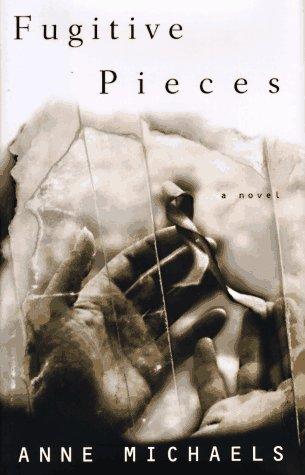
Fugitive Pieces
Anne Michaels · b. 1958 · Canada
Why it matters
A boy hidden in a Polish bog during the Holocaust is raised by a Greek geologist; decades later, a survivors' son reconstructs his life after his death. A poet's first novel, meditative and fragmentary, built entirely from the texture of memory and loss.
At a glance
Fragmentary, densely poetic prose moves associatively rather than through plot.
Deep dive
A Greek archaeologist pulls a seven-year-old Jewish boy half-buried in mud out of a Polish dig, and Michaels follows what a childhood submerged that early does to the adult trying to write his way back to it.
Written for readers who have finished the book. No plot recap, and nothing here is safe to read first.
Themes & symbolism
Jakob Beer survives his family's murder by hiding, and is found, filthy and mute with shock, by the Greek geologist Athos Roussos excavating the Bronze Age site at Biskupin, who smuggles him out of Poland and raises him first on the island of Zakynthos and later in Toronto. Michaels writes Jakob's trauma through the specific discipline Athos practices, geology, so that memory itself gets figured throughout the novel as sediment: experience doesn't vanish, it compresses into strata that keep exerting pressure on everything laid down afterward, which is also, not incidentally, how the prose itself works, dense, associative, circling the same images, bog bodies, buried cities, drowned villages, until they accumulate meaning through pressure rather than through plot.
The novel's second half hands the narration to Ben, a younger scholar who grew up in Toronto as the child of Holocaust survivors and becomes fixated on recovering Jakob's unpublished notebooks after his death, a structural choice that turns Fugitive Pieces into a book about transmission as much as about survival: trauma that skips a direct account and instead gets passed down through poetry, half-explained silences, and the compulsive scholarly need of a second generation to excavate a story the first generation could never fully tell.
Biskupin and the Archaeology of Erasure
Michaels roots Jakob's rescue in an actual site, Biskupin, a preserved Iron Age settlement in Poland that Nazi archaeologists attempted to claim as evidence of ancient Germanic rather than Slavic civilization, falsifying the historical record to fit their ideology even as they were, elsewhere on the same soil, erasing an entire living population. The novel uses that real historical distortion as its clearest image for what fascism does to both bodies and archives simultaneously, killing people and rewriting the ground they stood on so the killing leaves no trace anyone can verify.
Athos and the Ethics of Rescue
Athos never treats saving Jakob as heroism, and Michaels writes their relationship with a scrupulous refusal to let the older man's kindness stand in for the horror it can't undo: Athos teaches Jakob geology, languages, poetry, gives him an entire intellectual inheritance in place of the murdered one, but the novel keeps insisting that this generosity, however real, operates alongside Jakob's grief rather than resolving it, a rescue that saves a body without pretending to restore what the body lost.
The last seal: what actually happens, and why it lands the way it does.
The ending, explained
Jakob eventually marries Michaela, a much younger woman whose openness allows him, late in life, a version of intimacy his earlier marriage to the brittle, resentful Alex never permitted, and the novel treats this late happiness as real without letting it retroactively simplify anything that came before it. After Jakob's death in Greece, Ben travels there to search the house for Jakob's notebooks, driven by his own need, as a child of survivors himself, to find language equal to an inheritance of silence his own parents never gave him access to. Michaels ends not on a resolution to Ben's search but on his continued presence in Jakob's abandoned rooms, still looking, which the novel offers as the only honest ending available to a story about transmission: the record survives only as long as someone keeps choosing to keep excavating it.