
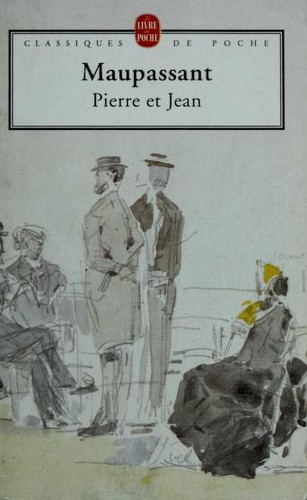
Pierre and Jean
Guy de Maupassant · 1850–1893 · France
Originally Pierre et Jean (French)
Why it matters
Two brothers' rivalry curdles into suspicion when one unexpectedly inherits a fortune. A tightly wound novel of jealousy and buried family secrets, and Maupassant's own favorite among his longer fiction.
At a glance
Tight, controlled prose with a single sustained psychological thread.
Deep dive
Why one brother's inheritance from an old family friend turns his sibling's mind into the real subject of a novel Maupassant insisted was built entirely on things left unsaid.
Written for readers who have finished the book. No plot recap, and nothing here is safe to read first.
Themes & symbolism
When the wealthy Léon Maréchal, an old family friend, leaves his entire fortune to Jean Roland alone and nothing to his elder brother Pierre, the unequal bequest reads at first like an ordinary domestic slight, and Maupassant lets Pierre's own jealousy do the actual detective work: turning the question over obsessively until he arrives, unprompted by any outside accusation, at the suspicion that Jean must be Maréchal's illegitimate son, meaning their mother had an affair years earlier that neither brother had ever had reason to imagine. The novel's real subject isn't the affair itself, which the reader is left to infer largely through Pierre's spiraling certainty rather than any confirmed scene, but the corrosive process of a mind that cannot stop assembling evidence once it has decided what conclusion that evidence needs to support.
Maupassant wrote a preface to the novel explicitly rejecting the idea that realism means photographic completeness, arguing instead that a novelist's whole skill lies in choosing which details to include and which to suppress in order to produce a convincing illusion of truth, and Pierre and Jean enacts that theory directly: the mother's affair is never staged, confessed outright, or narrated in full, it exists almost entirely as the thing Pierre infers and the thing the reader has to reconstruct alongside him, a novel built as deliberately around omission as around what's actually printed on the page.
The Norman port town of Le Havre, with its constant traffic of ships departing for distant postings, gives Pierre's mounting crisis its eventual outlet: unable to remain in a household where his own certainty has poisoned every ordinary family interaction, and unwilling to expose his mother's secret and destroy the family's fragile peace, Pierre enlists as a ship's doctor, choosing permanent departure over confrontation, the sea offering exactly the kind of clean, geographic escape the domestic plot has no other room for.
A Preface That Argues Against Its Own Century
Maupassant's preface to the novel, often read as a founding document of literary impressionism, breaks explicitly with the exhaustive documentary method his own mentor Zola had championed, insisting that a novel's job is illusion rather than inventory, selecting the telling detail over the complete record; Pierre and Jean's compressed, almost claustrophobic focus on one brother's private torment, rather than the sprawling social panorama of a Rougon-Macquart volume, is Maupassant putting that argument into direct practice rather than simply stating it.
The last seal: what actually happens, and why it lands the way it does.
The ending, explained
Pierre, unable to keep his suspicion to himself any longer, confronts his mother obliquely enough that she understands exactly what he has guessed without either of them ever stating it outright, and her silent, devastated reaction confirms the truth without a single word of outright confession passing between them. Jean, learning only that his brother has grown bitter and strange rather than the reason why, is left to work out his own understanding of the inheritance and his parentage largely offstage, while Pierre departs for his post as a ship's doctor, choosing distance over disclosure. The family reassembles around the absence he leaves rather than around any resolved reckoning, Maupassant closing the novel on exactly the kind of quiet, permanent rupture his preface had promised realism should prefer to melodrama.
Where to go next
 Guy de Maupassant · 1885Bel-AmiLvl 4Medium pace
 Gustave Flaubert · 1857Madame BovaryLvl 5Slow burn
 Émile Zola · 1885GerminalLvl 5Medium pace
 Leopoldo Alas "Clarín" · 1885La RegentaLvl 6Slow burn
 Joris-Karl Huysmans · 1884Against Nature (À rebours)Lvl 7Slow burn
 Kate Chopin · 1899The AwakeningLvl 5Medium pace