
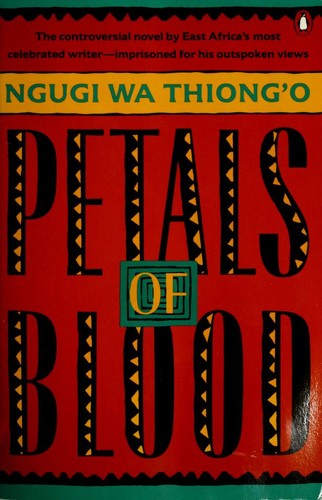
Petals of Blood
Ngũgĩ wa Thiong'o · b. 1938 · Kenya
Why it matters
A murder investigation opens onto the betrayals of postcolonial Kenya: the new elite feeding where the colonizers left off. It helped land Ngũgĩ in detention without trial; the radical African novel at full voltage.
At a glance
Sprawling structure interleaving four life histories with a present-day murder plot.
Deep dive
Three of Ilmorog's most powerful men are found dead in a fire on the same night, and Ngũgĩ spends the whole investigation walking backward through everything the road and capital did to a village that used to run on rain and rumor.
Written for readers who have finished the book. No plot recap, and nothing here is safe to read first.
Themes & symbolism
The novel announces its whole method in its structure: police inspector Godfrey interrogates Munira, Karega, Abdulla, and Wanja after a fire kills three of Ilmorog's most prominent men, and rather than build toward the answer in a straight line, Ngũgĩ lets each suspect's testimony pull the story backward into the years before the fire, when Ilmorog was still a drought-stricken village nobody in Nairobi bothered to develop. The murder-mystery scaffolding is a trap for the reader as much as for Godfrey: you come for a whodunit and are given instead a history of how a self-sufficient rural community became a satellite of capital, with the killings arriving only once that history has done its work.
Chui, Mzigo, and Kimeria are not simply victims, they are the novel's case study in what independence actually produced: a former schoolmaster turned company director, a factory owner, a landgrabbing MP, each one having converted colonial-era privilege into Kenyan-flag capitalism without ever redistributing anything downward. Ngũgĩ builds Ilmorog's road, the one thing the villagers march to Nairobi to demand in the novel's early chapters, into the very instrument of their undoing: paved access brings factories, banks, and brewers, and Ilmorog's own poor end up supplying labor and vice to an economy built entirely around men like Kimeria rather than around the village that begged for the road in the first place.
Wanja's arc from an idealistic young barmaid, pregnant once and betrayed once by Kimeria, into the owner of a brothel serving the same businessmen profiting from Ilmorog's transformation, is the novel's bitterest irony: survival under the new economy means running the exact enterprise that economy specializes in producing. Karega, the most politically awake of the four, moves from schoolteacher to labor organizer, the character through whom Ngũgĩ argues most directly that Kenya's problem after independence was never simply foreign ownership, but a Kenyan elite that stepped straight into the colonizer's old economic role.
Walcott's Swamp, Borrowed
Ngũgĩ takes his title and epigraph from Derek Walcott's poem 'The Swamp,' which imagines a landscape that looks peaceful from a distance and turns violent up close. Transplanted onto Ilmorog and Nairobi, the image warns against mistaking surface calm for safety: the village's drought and stagnation look like backwardness to the road-builders and bankers who arrive to fix it, while the real violence, exploitation reorganized rather than removed, hides inside the development that claims to cure the place. Petals, in that light, aren't beauty at all, they're what blooms directly out of blood already spilled.
The last seal: what actually happens, and why it lands the way it does.
The ending, explained
Kimeria arrives at Wanja's brothel expecting the same power over her he has held since he first seduced and abandoned her years earlier, and Wanja kills him herself, a private reckoning years in the making. That same night Munira, convinced Wanja holds some corrupting hold over Karega, sets fire to the brothel to destroy her; Abdulla pulls Wanja out alive, but Chui and Mzigo die in the blaze, and the fire's timing buries Wanja's killing of Kimeria under the larger catastrophe. Inspector Godfrey eventually works out that Munira started the fire, and Munira confesses freely, framing the arson as moral rescue rather than murder. The novel leaves Karega walking free, radicalized rather than chastened, already organizing the workers whose exploitation the investigation has just laid bare.
Where to go next
 Ngũgĩ wa Thiong'o · 1964Weep Not, ChildLvl 3Medium pace
 Ngũgĩ wa Thiong'o · 1965The River BetweenLvl 4Medium pace
 Ngũgĩ wa Thiong'o · 1967A Grain of WheatLvl 6Slow burn
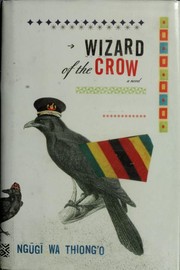 Ngũgĩ wa Thiong'o · 2006Wizard of the CrowLvl 7Medium pace
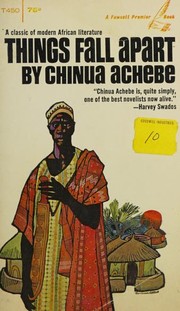 Chinua Achebe · 1958Things Fall ApartLvl 4Medium pace
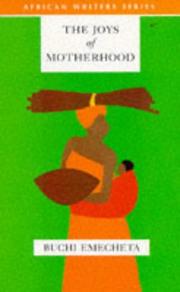 Buchi Emecheta · 1979The Joys of MotherhoodLvl 4Medium pace