
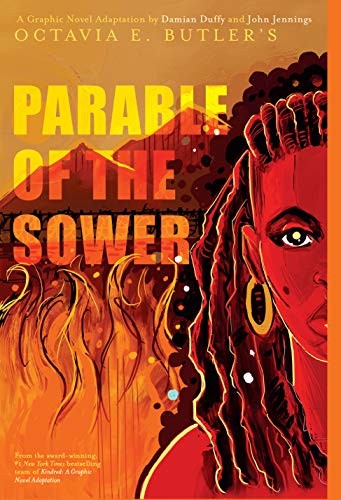
Parable of the Sower
Octavia Butler · 1947–2006 · United States
Why it matters
A young woman with hyperempathy leads survivors north through a collapsing, climate-ravaged California. Butler's prophetic dystopia reads more urgently with each passing year.
At a glance
Direct diary-form narration despite a bleak, complex world.
Deep dive
A fifteen-year-old girl born with the ability to feel other people's pain starts a religion out of the one idea she trusts completely, that change is the only real god there is, and writes her way north through a California collapsing around her.
Written for readers who have finished the book. No plot recap, and nothing here is safe to read first.
Themes & symbolism
Lauren Olamina's hyperempathy syndrome, inherited from her mother's prenatal drug use, makes her feel, physically, whatever pain or pleasure she witnesses in someone else. Butler builds the condition as both a genuine ethical asset, cruelty becomes nearly impossible for Lauren to inflict without suffering it herself, and a serious liability in a world organized around violence, since hurting Lauren costs her exactly as much as it costs whoever she's watching get hurt. That double edge, gift and exposure at once, is the novel's clearest argument against reading empathy as simply good: it has to be managed, even weaponized carefully, to survive.
Earthseed, the belief system Lauren spends the novel developing and eventually preaching, rejects a protective, anthropomorphic god in favor of a single governing fact: 'God is Change.' Rather than promising safety, Earthseed insists the only sane response to a universe defined by constant transformation is learning to shape that change deliberately instead of just absorbing it. Butler writes actual Earthseed verses as epigraphs opening most chapters, which lets the theology accumulate as something Lauren is genuinely building in real time rather than as a metaphor layered over the plot after the fact.
The Novel Structured as Scripture
The book is framed as Lauren's own journal, dated entries running from 2024 into 2027, each chapter opened by an Earthseed verse that stands slightly apart from the narrative underneath it. That double structure lets Butler hold two registers at once: the raw daily record of a society disintegrating, gated communities rationing water, arsonists high on a drug called pyro burning houses for the pleasure of watching fire, and the more deliberate, retrospective theology Lauren is assembling out of that record as she lives through it, verse by verse, well before she has any community to actually preach it to.
Robledo's Walls
Lauren's neighborhood, a walled Los Angeles suburb called Robledo, organizes its entire remaining sense of safety around a literal barrier, patrolled nightly by residents with guns, painted-over street signs meant to confuse outsiders, since police and fire service now function as expensive, unreliable subscriptions rather than public guarantees. Butler was extrapolating directly from early-1990s trends toward gated communities and privatized emergency services, and Robledo's wall, treated by its own residents as a reasonably solid promise of protection, is the novel's clearest image of a society mistaking enclosure for actual security.
The last seal: what actually happens, and why it lands the way it does.
The ending, explained
After Robledo's wall is finally breached and burned, Lauren leads a small band of survivors north on foot along the wrecked remains of a California highway, gathering allies, including Bankole, an older doctor she partners with, and burying several companions lost to violence along the way. The journey ends on land Bankole owns, where the group decides to stop moving and build something permanent rather than keep fleeing north indefinitely. They plant an oak tree over the graves of those who didn't survive the road and name the settlement Acorn, formally founding the first Earthseed community. Lauren closes the novel reciting Earthseed's 'Destiny' verse, the idea that humanity's purpose is eventually to take root among the stars, a hope she grounds not in certainty but in the same daily labor, planting, building, teaching, that got the group there in the first place.
Where to go next
 Octavia Butler · 1979KindredLvl 4Fast paced
 Philip K. Dick · 1962The Man in the High CastleLvl 6Medium pace
 Margaret Atwood · 1985The Handmaid's TaleLvl 5Medium pace
 Ursula K. Le Guin · 1969The Left Hand of DarknessLvl 6Medium pace
 Yevgeny Zamyatin · 1924WeLvl 5Fast paced
 Mary Shelley · 1818FrankensteinLvl 4Medium pace