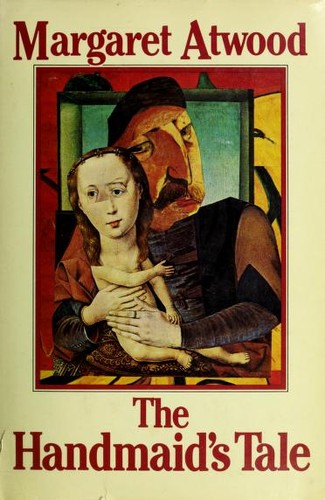
The Handmaid's Tale
Margaret Atwood · b. 1939 · Canada
Why it matters
A theocratic America reduces women to state-owned wombs, narrated by one who remembers freedom. Atwood insisted it contained nothing humans hadn't already done: a dystopia that only grows more cited.
At a glance
Plain first-person narration undercut by a traumatized, unreliable narrator's fragmented recall.
Deep dive
Why the novel's coldest chapter isn't set in Gilead at all, and what it does to a survivor's testimony once the danger is safely over.
Written for readers who have finished the book. No plot recap, and nothing here is safe to read first.
Themes & symbolism
Gilead sorts women by function and color before it sorts them by name: red for Handmaids, blue-striped for Wives, the drab green of Marthas, the multicolored uncertainty of Econowives. Offred herself is a patronymic with the woman erased — "of Fred" — and the novel never lets the reader forget it, since even her own memory of her real name becomes a kind of contraband she can only gesture toward. The Ceremony, with its enforced tableau of Wife-and-Handmaid intertwined on the same bed while the Commander recites Genesis's Rachel-and-Leah justification, is Atwood's most precise piece of world-building: state rape dressed in the borrowed authority of scripture, performed with everyone's clothes on and no one's consent asked, because Gilead's genius is bureaucratic thoroughness rather than chaos.
The one territory Gilead can't fully colonize is Offred's own narration — digressive, self-correcting, aware of its own unreliability ("I'm sorry there is so much pain in this story... I'm sorry it's in fragments"). That fractured, doubling-back voice is the novel's real subject: what total surveillance does to interiority when a woman's only remaining privacy is the inside of her own head. Moira's arc drives the same point further — her escape attempts are real and admirable, but the system simply reabsorbs her into Jezebel's as a costumed novelty, proof that individual rebellion, however brave, doesn't dent an apparatus built to metabolize resistance.
The Historical Notes
The academic epilogue, set some two centuries later at a symposium on "Gileadean Studies," is Atwood's cruelest joke and her most serious argument. Professor Pieixoto's lecture is full of smug puns (the "Underground Femaleroad," a titter at the audience's expense) and procedural nitpicking about whether Offred's account, reconstructed from a box of cassette tapes, can be trusted or dated precisely. It's a satire of the very discipline of history: the way scholarship can honor a testimony by preserving it and betray it by refusing to feel its weight. The Notes confirm what the main narrative can't — that Gilead eventually fell — which offers real hope. But they refuse to confirm what happened to Offred specifically, and in doing so demonstrate exactly the kind of institutional distancing that let Gilead happen in the first place.
Language as the last contraband
Literacy itself is rationed in Gilead — shop signs are pictures, not words, and women are forbidden to read at all — which is what makes the Commander's illicit invitation to play Scrabble so charged: a parlor game becomes, in this context, an act of real transgression, an intimacy built on nothing more subversive than letting Offred spell words again. The Latin phrase Offred finds scratched in her closet floor, left by a previous Handmaid, "Nolite te bastardes carborundorum," is fake Latin, schoolboy joke-Latin with no real grammatical standing, and Offred doesn't know that when she adopts it as a private talisman of defiance. That gap between the phrase's actual meaninglessness and the enormous private meaning Offred pours into it is the novel in miniature: resistance under total control is rarely strategic or effective, usually just symbolic, fragmentary, and desperately, movingly sincere anyway.
The last seal: what actually happens, and why it lands the way it does.
The ending, explained
Offred is led out of the Commander's house in a black van by men who identify themselves as Eyes, Gilead's secret police — the standard prelude to arrest, interrogation, and probable death. But Nick, her lover and the household's chauffeur, tells her to go with them and trust him, and the novel's main narrative simply ends there, refusing to disambiguate arrest from Mayday rescue. That refusal is the point: Offred's fate, like so much else in her account, survives only as testimony, not verified fact. The Historical Notes then step back two hundred years to confirm the regime collapsed without ever locating Offred within that collapse — a structure that lets the book hold both despair and hope at once, exactly the way its narrator has had to.