
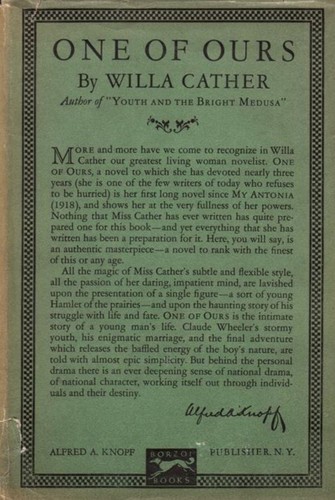
One of Ours
Willa Cather · 1873–1947 · United States
Why it matters
Claude Wheeler, a frustrated Nebraska farm boy, escapes stifling prairie life by enlisting in the First World War, finding on the French front the purpose home never gave him. Cather's Pulitzer winner turned her pastoral gaze toward war and disillusion, dividing critics ever since.
At a glance
Clear, controlled prose stays accessible despite its structural break between prairie and battlefield halves.
Deep dive
A Nebraska farm boy finds in the First World War a sense of purpose and even beauty his prosperous, suffocating prairie life never gave him — and Cather refuses to say whether that's tragedy or the one clean thing that ever happened to him.
Written for readers who have finished the book. No plot recap, and nothing here is safe to read first.
Themes & symbolism
The novel's two halves are a deliberate diagnosis: everything in the Nebraska section is material abundance and spiritual starvation — a domineering father, a marriage to the cold, pious Enid Royce that curdles before it starts, a Midwest so comfortable it has no use for a mind like Claude's. When the war arrives, Cather doesn't send Claude to it reluctantly; he goes toward it, and the prose warms the moment he's aboard ship, responding to French landscape and culture and to the unguarded camaraderie of men in a way nothing at home ever earned from him. That inversion — atrocity as liberation — is the book's real provocation.
Critics split over that provocation from the day of publication and have never really stopped: Hemingway, among others, savaged the combat sections as a civilian's fantasy of war (Cather never saw the front), reading the novel as accidentally, embarrassingly sincere about glory. The more durable reading takes the irony as fully intentional — that Cather isn't glorifying the war so much as indicting the emptiness that made it feel like glory, using Claude's numbed exaltation to measure just how little peacetime Nebraska had to offer a man hungry for meaning.
A Critical Fault Line
The Pulitzer committee's choice was controversial precisely because it rewarded ambiguity readers wanted resolved one way or the other. Cather never adjudicates between the two available readings in her own voice, and that refusal is the point: a novel willing to sit with the possibility that a wasted life and a meaningful death can be the same event is doing something more unsettling than either war novel it's sometimes mistaken for — neither a recruitment poster nor a straightforward anti-war tract.
Cather's Own War Novel Problem
Cather researched the war sections through her cousin G.P. Cather's letters home before his own death in France, and through interviews with veterans, rather than firsthand experience, a fact contemporary reviewers used to dismiss the novel's second half as sentimental. Later critics have argued the opposite: that Cather's outsider vantage is exactly what lets her see the war as Claude does, as an idea imported wholesale from elsewhere and never quite tested against reality, which is precisely the numbness the novel is diagnosing rather than sharing.
The last seal: what actually happens, and why it lands the way it does.
The ending, explained
Claude is killed in the war's final push, in combat that he experiences, right up to the moment of death, as fulfilling rather than futile — Cather grants him no disillusioning glimpse of what peace will look like for the men who survive him. That timing is the whole design: many of his comrades live to watch the war's meaning curdle into cynicism and drift, while Claude dies still inside the one experience that ever made him feel he mattered. His mother finds a bleak comfort in exactly this, relieved that he never lived long enough to be disappointed. The novel closes without ruling on whether that's mercy or the cruelest joke it could play on him.
Where to go next
 Willa Cather · 1913O Pioneers!Lvl 3Medium pace
 Willa Cather · 1918My ÁntoniaLvl 3Medium pace
 Henry James · 1881The Portrait of a LadyLvl 6Slow burn
 Edith Wharton · 1905The House of MirthLvl 5Medium pace
 Mark Twain · 1884Adventures of Huckleberry FinnLvl 5Fast paced
 James Baldwin · 1956Giovanni's RoomLvl 5Medium pace