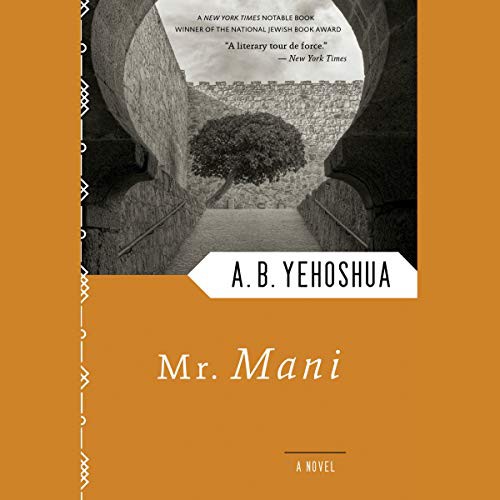
Mr. Mani
A. B. Yehoshua · 1936–2022 · Israel
Originally Mar Mani (Hebrew) · translated by Hillel Halkin
Why it matters
Five conversations, each heard only from one side and moving backward across two centuries, trace one family's entanglement with Zionism, madness, and belonging. Yehoshua's most structurally audacious novel, widely considered his masterpiece.
At a glance
Five one-sided dialogues moving in reverse chronological order demand constant reconstruction of the missing half.
Deep dive
Five conversations, each one printed with only a single side of the dialogue on the page, run backward through five generations of the same family, and the reader has to reconstruct not just what was said but who else is even in the room.
Written for readers who have finished the book. No plot recap, and nothing here is safe to read first.
Themes & symbolism
Yehoshua's structural gamble is total: across all five conversations, spanning a 1982 army base during the Lebanon war back to Ottoman-ruled Jerusalem in 1848, we hear only one speaker in each, and must infer everything the silent interlocutor says or does from what gets repeated back to them. A scholarly framing note precedes every section, naming where and when the exchange supposedly took place and who transcribed it, adding a second layer of mediation between the reader and events that were already only half-audible to begin with.
Running the family backward through history rather than forward means effects arrive before their causes. A grandson's crisis is fully dramatized before the reader ever learns the ancestral obsession that produced it, so understanding in this novel has to work the way personal understanding of a family often actually does, symptoms known intimately long before anyone traces them back to their origin.
What recurs across five generations of Mani men is a compulsion to dissolve boundaries the rest of the world treats as fixed: between Arab and Jew, the living and the dead, self and other. The novel's earliest and strangest Mani, encountered only in its final, chronologically first section, conceives a scheme so far outside ordinary politics that later generations can only inherit its aftershock without ever fully grasping its logic, a family relationship to the idea of Zion that predates Zionism as an organized movement by decades.
A Novel Told in Answers Only
Withholding one half of every conversation forces the reader into active reconstruction rather than passive reception, guessing at questions from the shape of the answers, inferring a listener's shock or boredom from a speaker's sudden change of subject. Yehoshua uses the same device the family itself is trapped by: each generation of Manis inherits an older relative's convictions second-hand, filtered and partial, and has to reconstruct the missing half for themselves, exactly as the reader is being made to do on every page.
The First Mani's Strange Zionism
The earliest Mani we meet, in the novel's final section set in 1848, arrives at an idea few historical actors of the period would recognize: rather than waiting for a Jewish return to the land to provoke conflict with the Arabs already living there, he proposes dissolving the coming quarrel in advance through intermarriage and shared parentage, blurring the very distinction a national movement would need in order to exist. Yehoshua does not present this as prophecy or as a lost better path history failed to take. It reads instead as one family's singular, unstable relationship to an idea everyone around them was still decades from taking seriously, planted so early it has curdled into something closer to madness by the time it reaches his descendants.