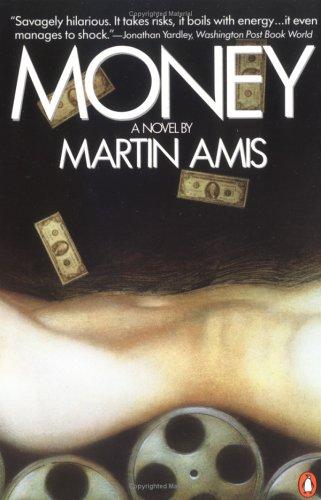
Money
Martin Amis · 1949–2023 · England
Why it matters
A self-destructive advertising director burns through appetite, pornography, and greed on a transatlantic bender that never quite ends. Amis's savage comic style made 1980s excess its own kind of literature.
At a glance
Manic first-person voice, dense wordplay, and a self-referential authorial cameo.
Deep dive
An advertising man's champagne-and-pornography bender across London and New York, narrated by a mind almost too addled to trust — complicated further by a novelist named Martin Amis, who appears inside the story to watch him with open suspicion.
Written for readers who have finished the book. No plot recap, and nothing here is safe to read first.
Themes & symbolism
Money runs on the premise that appetite is the only ideology left standing in Thatcher-and-Reagan-era capitalism: John Self drinks, eats, buys, and consumes pornography in an endless chain of substitutions, as if sex, food, and cash were all the same fungible stuff wired to the same nervous system. His body does the moral commentary the plot won't bother with — the hangovers, the impotence, the wrecked teeth and encroaching blackouts keep physically interrupting the shoot for his vanity film, "Good Money"/"Bad Money," as if excess were setting its own deadline.
The cameo by a character called "Martin Amis" — hired, in the story, to punch up Self's script, and who studies Self with a cool, faintly clinical curiosity — turns the whole novel into a hall of mirrors. An author steps inside his own unreliable narrator's account to remind the reader that everything here has been shaped and angled, and that Self, sharp as he is about brand names, exchange rates, and hangover math, is constitutionally unable to read the plot he is actually inside of. That blindness, not the drinking, is the novel's real subject: a virtuoso consumer who cannot see who is consuming him.
The Prose of Excess
Amis writes Self's voice in a transatlantic sprint of puns, brand names, and self-lacerating one-liners, so the style itself performs the novel's argument: language, like money and appetite, is just another currency being spent as fast as it comes in. Self's malapropisms and verbal tics are frequently smarter than he is — the prose keeps noticing connections its narrator can't, which is how Amis lets you see past Self's account of himself without ever having to break the first-person illusion.
The last seal: what actually happens, and why it lands the way it does.
The ending, explained
The whole "Good Money" production is revealed as fiction: Fielding Goodney was never a backed producer, only someone running enormous debts up in Self's name and passing them off as investment capital, in a scheme tangled up with Self's ex, Selina, and with the running comic fraud of his father Barry's invented childhood debts. There is no film, no studio money, and no way to repay what's been borrowed. Self loses Selina, his flat, his credit, and very nearly his life, before landing broke, sobered by necessity rather than virtue, in a plainer world he'd spent the whole book trying to buy his way out of — Amis's punchline being that the con needed Self's own greed to work, and worked perfectly.