
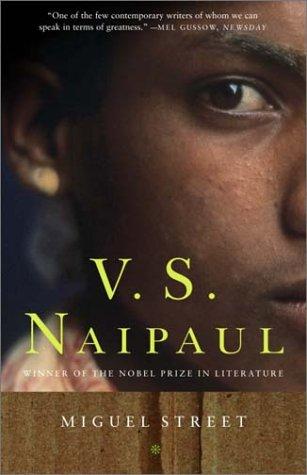
Miguel Street
V. S. Naipaul · 1932–2018 · Trinidad / England
Why it matters
Seventeen linked sketches of the eccentrics, dreamers, and failures on one Port of Spain street, seen through a watchful boy's eyes. Naipaul's wry, affectionate debut: the Caribbean's oral storytelling tradition folded into deadpan English prose.
At a glance
Plain, episodic comic sketches make this the most accessible entry point in his catalogue.
Deep dive
Seventeen sketches of one Port of Spain street, its prophets, liars, and failed inventors, seen through a boy too young to notice he's about to outgrow every one of them.
Written for readers who have finished the book. No plot recap, and nothing here is safe to read first.
Themes & symbolism
The unnamed narrator grows up on Miguel Street admiring men the book quietly reveals to be failures: Bogart, who vanishes for months at a time and returns wearing a stranger's swagger, later turns out to be running from a marriage rather than living some life of mystery. Man-Man, the street's self-declared prophet, escalates from eccentric sign painting to arranging his own mock crucifixion as a publicity stunt for God, and is carted off to the asylum when the crowd he's counting on to save him just watches instead. Naipaul lets the boy report each disappointment in the same admiring tone he actually felt at the time, so the gap between what the street believes about itself and what's plainly happening opens up entirely in the reader's head, never in the prose.
Elias studies for the same set of exams three times, certain each attempt will be the one that gets him off the street and into a real profession, and fails every time for reasons that have less to do with his intelligence than with a colonial system rigging the results before he sits down. Hat, the street's most magnetic presence, cycles through cricket, common-law marriage, and a jail term with the same easy charm, absorbing the street's setbacks without ever seeming changed by them. Naipaul builds seventeen of these small defeats side by side until the pattern becomes the argument: Miguel Street isn't a backdrop for one boy's coming of age so much as a demonstration of exactly what he has to leave in order to have one.
A Colonial Island Learning What Independence Costs
Naipaul sets these sketches in wartime and postwar Trinidad, a colony whose men enlist, profiteer off American servicemen stationed nearby, or simply watch imperial history happen somewhere else, and the scholarship that finally removes the narrator is itself a colonial mechanism, a single yearly ticket out administered by the same system that gave the street so little else. Every ambition on Miguel Street gets measured against how far it can travel outside Trinidad, which is Naipaul's own quiet argument about what a colony actually manufactures: not futures, but the desire to leave and find one somewhere else.
The last seal: what actually happens, and why it lands the way it does.
The ending, explained
The narrator wins a scholarship to study in London, the one route off the street that every other character on it has tried and failed to find for himself. On the morning he leaves, the whole street turns out to see him off, the same crowd that gathered for Man-Man's aborted crucifixion and every other spectacle the block has produced, and Naipaul has the boy perform his own exit with the same self-conscious flourish the street taught him: walking to the plane without turning around, letting his shadow shrink behind him rather than looking back at the people who raised him. It's the one clean departure Miguel Street ever produces, and Naipaul earns it by having spent sixteen chapters cataloguing every attempt that failed.
Where to go next
 V. S. Naipaul · 1961A House for Mr BiswasLvl 5Medium pace
 V. S. Naipaul · 1971In a Free StateLvl 6Medium pace
 V. S. Naipaul · 1979A Bend in the RiverLvl 5Medium pace
 V. S. Naipaul · 1987The Enigma of ArrivalLvl 6Slow burn
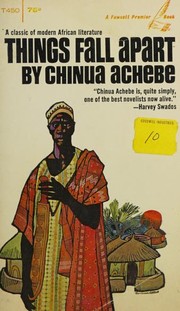 Chinua Achebe · 1958Things Fall ApartLvl 4Medium pace
 Ngũgĩ wa Thiong'o · 1967A Grain of WheatLvl 6Slow burn