
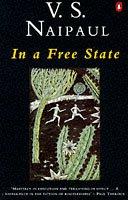
In a Free State
V. S. Naipaul · 1932–2018 · Trinidad / England
Why it matters
A British colonial couple's tense drive across a newly independent East African country anchors a composite of stories and journal entries, all circling the same raw dislocation of decolonization. Winner of the 1971 Booker Prize, Naipaul's coldest early diagnosis of the postcolonial world.
At a glance
A composite structure (two stories and a journal framing the title novella) requires piecing together its unifying argument.
Deep dive
How a steamer's own travel diary frames three unrelated stories about Indian and English lives displaced by decolonization, tied together only by the same suspicious word: freedom.
Written for readers who have finished the book. No plot recap, and nothing here is safe to read first.
Themes & symbolism
Naipaul builds the book out of pieces that share no characters and barely share a setting: a prologue and epilogue drawn from his own 1962 journal of a cramped steamer crossing from Piraeus to Alexandria, and inside that frame, two first-person novellas and a third-person title story that only rhyme thematically. One Out of Many follows Santosh, an Indian domestic servant brought to Washington by his diplomat employer, who defects into an undocumented, isolated freedom that costs him his caste, his community, and eventually a marriage to a hostile stranger he takes purely for papers, ending up freer than he's ever been and lonelier than he ever expected freedom to feel.
Tell Me Who to Kill gives the same argument a rawer, angrier voice: an unnamed Trinidadian narrator sacrifices everything, including his own sanity, funding his slow-witted brother Dayo's education in London, and the story dissolves into the narrator's own unravelling syntax as the sacrifice fails to produce anything worth the cost. The title novella follows Bobby, a gay English colonial officer, and Linda, a colonial administrator's wife, driving across an unnamed East African country in the middle of a coup, its ethnic violence closely modeled on Idi Amin's Uganda, and lets their casual racism and complacent Englishness curdle into real danger once the country stops pretending their old colonial privileges still apply.
A Real Voyage Framing Three Invented Ones
The prologue and epilogue aren't fiction at all in the ordinary sense: Naipaul adapted them from his own 1962 diary of a Greek steamer crossing to Egypt, complete with a stateless refugee the other passengers mock and abuse for the length of the voyage. Placing real, unresolved cruelty at both ends of the book, rather than inside one of the invented stories, is Naipaul's way of insisting the theme isn't a literary device: displacement and the false promise of freedom were things he had personally watched happen before he ever wrote a line of fiction about them.
A Booker Prize for a Book That Refuses to Cohere
In a Free State won the Booker Prize in 1971, an unusual choice for a book a skeptical judge could reasonably call three stories and a travel diary rather than a novel. The prize committee's willingness to reward that refusal to cohere is itself part of the book's afterlife: Naipaul was arguing that the postcolonial world it describes doesn't cohere either, that Santosh's Washington, the narrator's London, and Bobby's East Africa are not variations on one story but proof that decolonization produced no single story at all.
Where to go next
 V. S. Naipaul · 1959Miguel StreetLvl 3Fast paced
 V. S. Naipaul · 1961A House for Mr BiswasLvl 5Medium pace
 V. S. Naipaul · 1979A Bend in the RiverLvl 5Medium pace
 V. S. Naipaul · 1987The Enigma of ArrivalLvl 6Slow burn
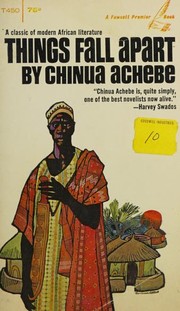 Chinua Achebe · 1958Things Fall ApartLvl 4Medium pace
 Ngũgĩ wa Thiong'o · 1967A Grain of WheatLvl 6Slow burn