
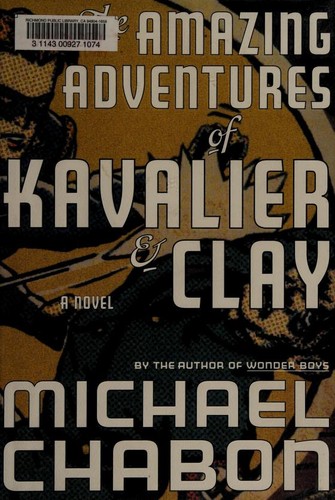
The Amazing Adventures of Kavalier and Clay
Michael Chabon · b. 1963 · United States
Why it matters
Two Jewish cousins invent a Nazi-punching superhero in 1939 New York, one of them smuggling his own escape from occupied Prague into every panel. Chabon's Pulitzer winner treats the comic book as American myth-making in real time.
At a glance
A sprawling, digressive plot spans decades, continents, and comic-book lore.
Deep dive
Why a golem smuggled out of Prague in a coffin is the real hero of a book about a cartoon strongman who punches Hitler.
Written for readers who have finished the book. No plot recap, and nothing here is safe to read first.
Themes & symbolism
Houdini is the novel's patron saint, and escape is its actual subject rather than its genre trapping: Joe trains as an escapologist under a Prague magician before he ever draws a panel, and the golem he smuggles out of the city — sealed inside a coffin dressed up as a corpse being shipped abroad — is the book's founding escape act, protective folk magic literalized and then rendered useless the instant it crosses the ocean. Chabon's cruelest structural joke is that escapism, however virtuosic, never rescues anyone who actually matters: the golem can't save Prague's Jews, the Escapist can't free Europe from the page, and Joe's own escape leaves his mother and younger brother, Thomas, behind.
The comic book becomes the novel's vocabulary for hidden selves: secret identities, origin stories forged in trauma, an arch-nemesis drawn crudely enough to be a Nazi with a swastika armband — genre conventions that let American Jewish artists fight a war in effigy years before their country would fight it for real. That same vocabulary does double duty for Sammy, whose own secret identity, his attraction to men, gets plotted and re-plotted throughout the book as a story he can draw but not yet tell about himself, until Tracy Bacon, the radio actor who voices the Escapist, makes it briefly, dangerously literal.
The Golem as a Theory of Art
Chabon plants his title's pun early — golem-clay and Sammy Clay share a substance — and keeps asking what an artificial protector, made by frightened, ordinary hands, can actually accomplish. The golem is inert cargo once it reaches Brooklyn, boxed up and eventually lost, but its logic, art as improvised defense against an unstoppable enemy, migrates straight into Empire Comics, where Joe channels the same desperate craft into the Escapist. The novel never quite resolves whether that transfer is heroic or merely consoling, since Joe draws his fiercest, most cathartic Nazi-punching panels in the very months he can do nothing for Thomas.
Sammy's Long Closet
Sammy's arc is the book's quieter tragedy, running on its own clock beneath Joe's more operatic one: a childhood of polio and a distant father primes him for self-erasure long before his sexuality gives him something specific to erase. His romance with Tracy Bacon, ended by a raid that could have destroyed both their careers, teaches him to fold desire back into invisibility for another decade of a marriage of convenience to Rosa. That the novel eventually grants him a late, hard-won exit — not punishment, not melodrama, just a door finally opened — sets his story apart from the very genre tropes he spends the book drawing for other people.
The last seal: what actually happens, and why it lands the way it does.
The ending, explained
Joe disappears from Rosa and their infant son, Tommy, for years after Thomas dies when the evacuation ship carrying him from occupied Europe is torpedoed — a loss Joe processes as proof he forfeited any right to a family by failing to save his brother. Wartime service and a stretch of near-total isolation in Antarctica extend the exile before he can finally return to New York and make himself known to a son who has grown up believing him dead, rebuilding a life with Rosa on more honest terms than either the marriage or the escapism that preceded it. Sammy's resolution runs alongside rather than through Joe's: having spent the novel closeted, he leaves for a life of his own making in California, the book closing not on reunion for its own sake but on both men finally choosing lives they can actually live in.
Where to go next
 Joshua Cohen · 2021The Netanyahus: An Account of a Minor and Ultimately Even Negligible Episode in the History of a Very Famous FamilyLvl 6Medium pace
 Charles Johnson · 1990Middle PassageLvl 5Fast paced
 Hugo Claus · 1983The Sorrow of BelgiumLvl 6Medium pace
 Jhumpa Lahiri · 1999Interpreter of MaladiesLvl 3Medium pace
 V. V. Ganeshananthan · 2023Brotherless NightLvl 5Medium pace
 E. L. Doctorow · 1975RagtimeLvl 6Fast paced